8 min to read
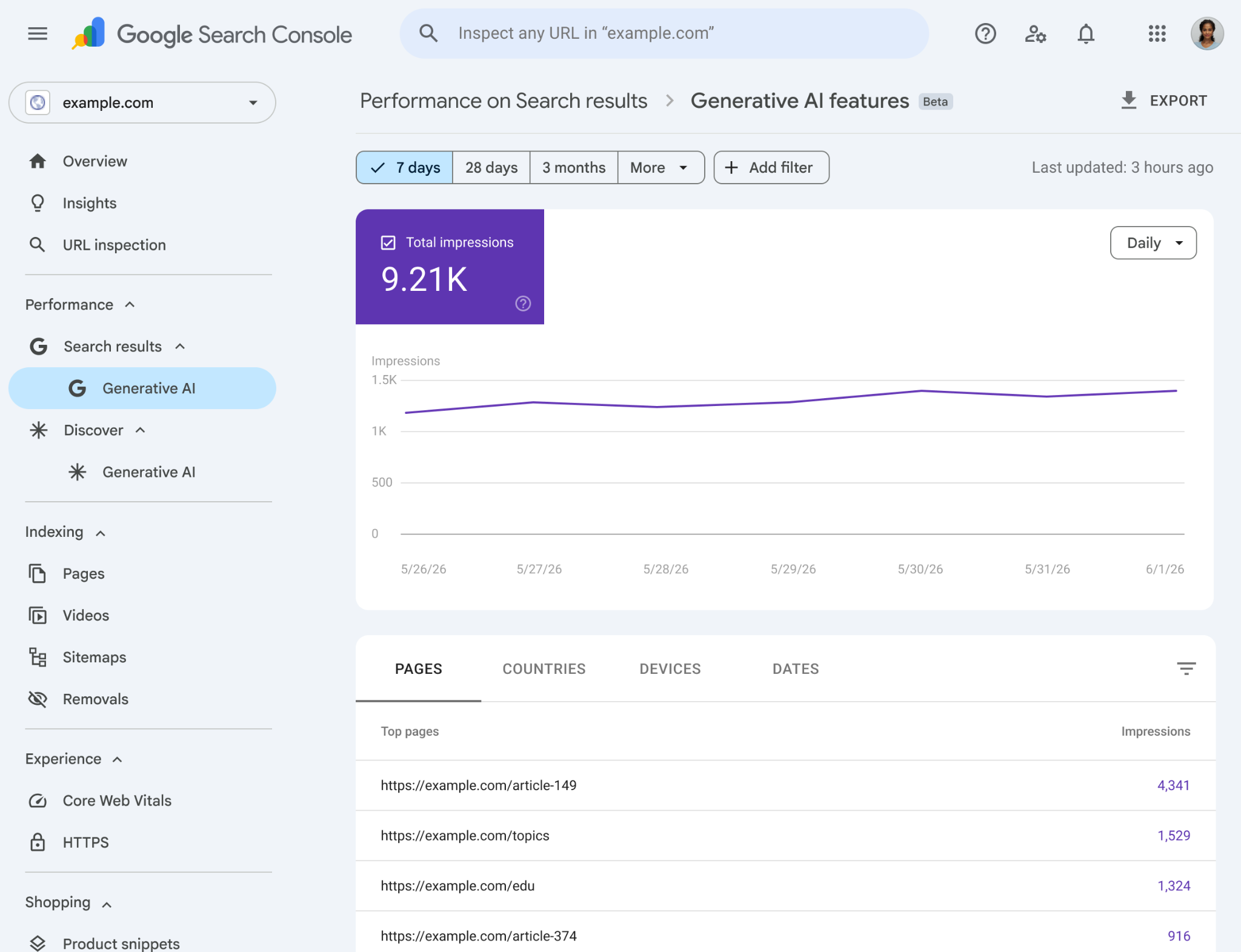
I have been staring at the same Search Console screenshot for a week now, and I keep coming back to one uncomfortable thought: we finally got the data we asked for, and most marketing teams are not going to like what it says.
On June 3rd, Google announced Search Generative AI performance reports in Search Console — dedicated reporting for how your pages show up inside AI Overviews, AI Mode, and the generative features in Discover. Barry Schwartz covered the rollout on Search Engine Land, and if you read one industry piece this month, make it that one. The reports are landing first with site owners in the UK and expanding globally over the coming weeks, which means that sometime this quarter, you or your SEO lead will open Search Console and see, for the first time, an official Google account of your AI search visibility.
Here is the part nobody puts in the launch blog post: the reports show impressions, pages, countries, devices, and date trends. They do not show clicks. And that omission is not a bug or a v1 limitation to be patched later. It is the message.
Let me explain why I think this is the single most important shift for marketing directors between now and October — and what we are doing about it at Codedesign with our own clients.
The numbers behind the shift
Some context, because the scale of this is easy to underestimate. AI Overviews now reach more than 2.5 billion monthly users. AI Mode — the fully conversational search experience Google expanded at I/O — has passed 1 billion monthly active users. This is not an experiment on a fraction of queries anymore. For a growing share of your audience, this IS Google.
Now put that next to the independent research on click behaviour: studies are reporting a roughly 83% zero-click rate on queries with AI Overviews, and around 93% zero-click in AI Mode. Read those numbers again. In AI Mode, more than nine out of ten sessions end without anyone visiting a website.
And here is the third data point that completes the picture, the one I have been quoting in every client meeting this month: only about 8% of the sources ChatGPT cites come from Google's top ten results. Ranking well on Google does not mean an AI assistant will mention you. It is a different game with different rules, played on a board most marketing teams have never audited.
So we have three facts. AI search is now the mainstream interface. AI search barely sends clicks. And the sources AI systems trust do not map neatly onto the rankings you spent the last decade optimising for.
If your dashboards still treat organic sessions as the north star metric, you are about to have a very confusing autumn.
What I saw with a client in the Gulf market

Let me make this concrete, because abstract trend pieces are exactly the kind of content AI summarises so nobody has to read them.
We work with an e-commerce group in the Gulf region — I will keep them anonymous, but think consumer electronics and home appliances across the UAE and Saudi Arabia. Since spring, their non-brand organic traffic has been sliding quarter over quarter. A year ago, a decline like that would have triggered a full technical SEO audit and some difficult conversations. This time, something strange happened alongside it: revenue from organic-assisted journeys held steady, and their branded search volume actually grew.
When we dug into the analytics, we found the explanation in a pattern that matches what the broader research is showing: visitors who arrive after an AI assistant pointed them somewhere behave completely differently. Industry data suggests people referred by chatbots view nearly twice as many pages and spend about twice as long on site. We saw the same shape in this client's data. Fewer visitors, but the ones who came were further down the funnel, better informed, and dramatically more likely to convert.
What was happening upstream? Shoppers in that market were asking AI assistants things like "best washing machine for a large family under 3,000 dirhams" and arriving at the site with the comparison phase already done. The awareness and consideration stages — the stages we used to capture with category pages and buying guides — were happening inside the AI layer, invisible to us until now.
That is exactly the blind spot the new Search Console reports start to illuminate. For the first time, you will be able to see that your buying guide earned hundreds of thousands of AI Overview impressions even though it collected a fraction of the clicks it used to. Your content is working. It is just working somewhere you could not see.
For this client, we stopped treating organic sessions as the KPI and rebuilt the measurement model around three things: AI visibility (impressions in AI surfaces, plus assistant citation tracking), branded demand (branded search volume and direct traffic as a proxy for AI-driven brand recall), and per-visitor value (revenue per organic session, which has been climbing steadily). The traffic chart still points down. The business chart does not.
Why "good content wins" is both true and useless
I read the July Google webmaster report on Search Engine Roundtable last week — it is a ritual at this point, the way some people read match reports — and one thing stood out. Liz Reid, who runs Search at Google, kept repeating the same message in every venue: good content is what wins. Google also confirmed, for those keeping score, that LLMs.txt files will not help or hurt you either way. Save yourself the sprint ticket.
"Good content wins" is true. It is also the least actionable sentence in marketing. Of course good content wins. The question a marketing director actually faces is: good for whom, measured how, and funded by which line of the budget when the traffic reports my CFO reads are down 30%?
Here is my honest, slightly contrarian take: the zero-click panic is misdirected. Clicks were never the product. Clicks were a proxy — a crude, gameable proxy — for attention and trust. For twenty years we optimised the proxy, and an entire industry grew up around doing so. AI search is not killing attention or trust. It is killing the proxy. What replaces it is harsher and more honest: either the machines synthesising answers consider your brand a source worth citing, and buyers arrive pre-sold — or you are simply absent from the conversation, and no amount of blue-link ranking will save you.
I wrote about the early shape of this in Google Enhances Search with AI Mode on our blog, and about the content-quality side in Google Didn't Kill AI Content — You're Just Using It Wrong. Both pieces have aged in one direction: the shift came faster than I expected.
The isolation problem
There is a deeper thread here that goes beyond marketing mechanics, and it is one we keep pulling on over at Voice of Experts, the podcast and newsletter I run alongside the agency. In a recent conversation with Virginia Dignum, who advises the UN on AI governance, she made a point I have not been able to shake: AI is an extension of human skill, not a replacement for it. The businesses getting this transition right are the ones using AI to amplify a genuine point of view. The ones getting it wrong are automating the soul out of their communication — publishing more content than ever and saying less than ever.
We have also been writing in the newsletter about what I call the real AI bubble — not a valuation bubble, but a bubble of isolation: companies talking to machines that talk to machines, with the human buyer increasingly mediated out of the loop. The new Search Console reports are, in a strange way, the first official map of that bubble. They show you where your brand lives inside the machine layer.
If that framing resonates, the Weekly Review we publish on Voice of Experts curates these shifts every week — it exists precisely because keeping up with this stuff has become a job in itself.
The 90-day playbook I am giving our clients
Enough diagnosis. Here is what I would actually do between now and mid-October, whether or not you work with an agency like ours.
- First, claim the data the moment it arrives. The AI performance reports are rolling out progressively. The day they appear in your Search Console property, export a baseline. You want a clean "before" picture: which pages earn AI impressions, in which countries, on which devices. In three months, this baseline will be the most valuable spreadsheet in your marketing department.
- Second, audit your assistant footprint by hand. Do not wait for tooling. Take your twenty most commercially important queries and ask them — in ChatGPT, in Gemini, in AI Mode, in Perplexity. Note who gets cited. Remember the 8% figure: your Google rankings tell you almost nothing about this. In every audit we have run at Codedesign this year, clients were shocked by which competitors the assistants trusted. Often it was not the market leader. It was whoever had the clearest, most structured, most quotable answer.
- Third, restructure your money pages to be citable. AI systems lift passages, definitions, comparisons, and data points. Pages that bury the answer under eight hundred words of preamble get skipped. Pages that state the answer plainly, support it with first-party data, and attribute it to a named expert get cited. This is not "writing for robots" — it is the discipline of being quotable, and it happens to serve human readers too.
- Fourth, shift budget toward branded demand. If the AI layer is going to compress the consideration phase, the battle moves to being the brand the buyer names in the prompt. That means the unfashionable stuff works again: digital PR, expert commentary, podcast appearances, original research, community. The brands that get named in prompts win before retrieval even happens.
- Fifth, redefine the KPI conversation with your leadership before the traffic chart does it for you. This is the one that decides careers. If your CEO's mental model is "organic traffic = marketing performance," the next two quarters will be a slow-motion crisis. Walk them through the visibility-versus-traffic split now, on your terms, with your baseline data. Show revenue per session. Show branded demand. Reframe the story before someone else frames it as failure.
None of this is speculative. All of it is executable this quarter with the team you already have.
Where I land
I have been doing this for more than two decades, through Panda, Penguin, mobile-first, HTTPS, Core Web Vitals, the Helpful Content era — every one of them announced as the end of SEO. This one is different, and I want to be precise about why. Previous updates changed how you win the click. This one changes whether the click exists. That is not an algorithm update. That is a business model update — Google's, and by extension, yours.
The marketers who struggle this year will be the ones defending a metric. The ones who thrive will be the ones defending an outcome — demand, revenue, brand preference — and staying flexible about which channels and surfaces deliver it.
Google finally gave us a window into the AI layer. Most teams will glance at it, sigh at the click column that is not there, and go back to their old dashboards. Please do not be most teams.
So here is my question for you, and I genuinely want replies on this one: when your organic traffic drops but your revenue holds, what will you tell your board — and do you have the measurement in place to tell that story credibly? Hit reply or leave a comment. I read all of them, and the best answers usually end up (with permission) in a future issue.
And if you want a second pair of eyes on your AI search baseline before the quarter closes, that is exactly the kind of work we do at Codedesign — start with our thinking at codedesign.org/our-thoughts, or subscribe to voiceofexperts.com for the weekly signal.
— Bruno
 |
Author BioBruno Gavino is the Founder & CEO of Codedesign, an international digital marketing agency helping growth-stage companies build data-driven, AI-ready marketing systems. This article was written by Bruno with the help of Gemini, Claude and Codedesign Copywriting AI Agents
My Linkedin: https://www.linkedin.com/in/brunogavino/ |
