7 min to read
Your Google traffic is disappearing. Not slowly — fast. And most Marketing Directors I talk to haven't quite figured out why yet.
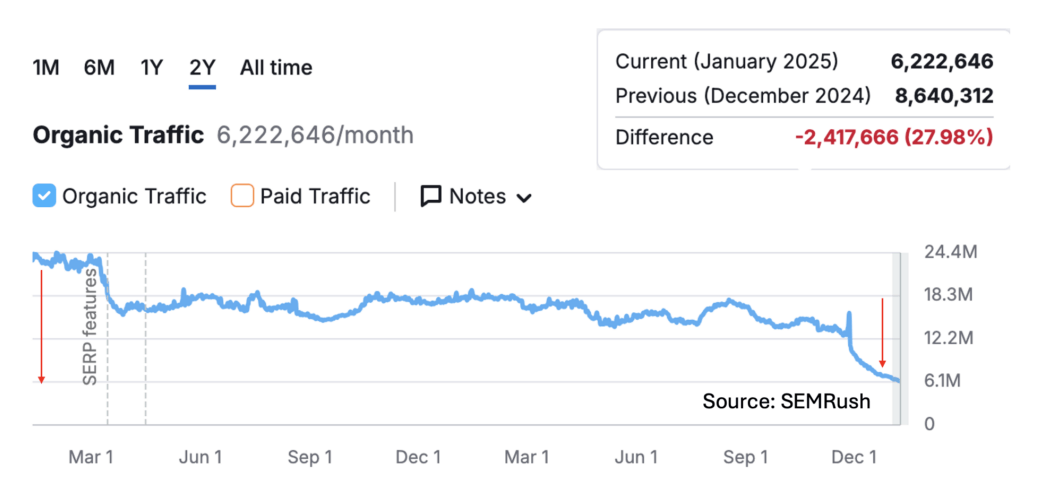
Let me give you the numbers first, then I'll tell you what I'm actually seeing with clients.
As of March 2026, Google's AI Overviews appear on 48% of all searches — up from 34.5% just three months earlier. That's a 58% increase in one quarter. When an AI Overview shows up, the organic click-through rate for position one drops roughly 18%. For informational queries — the kind that used to fill your blog with traffic — some studies are showing declines in the 30-40% range. A Seer Interactive study found that queries with AI Overviews saw organic CTR fall from 1.76% to 0.61%. That's a 61% collapse.
And with Google's newer AI Mode? According to Semrush data cited recently, 93% of those sessions end without a single click to an external website.
Ninety-three percent.
If you built your content strategy around driving traffic from Google, that number should stop you cold.
What I'm Actually Seeing on the Ground
A few weeks ago I was reviewing dashboards with a client of ours — a B2B SaaS company in the financial compliance space, strong European presence. They had invested seriously in content over the last two years. Good content, honestly. Thoughtful long-form pieces, expert interviews, proper SEO. Their blog was pulling 40-50k organic visits a month by early 2025.
By Q1 2026, it was down to 27k. Same domain authority. Same rankings — actually better rankings on some terms. But the traffic just wasn't converting to clicks anymore. Google was answering the question for the user before they ever got to the site.
The frustrating part? They were ranking #1 for several of the terms where AI Overviews were eating their clicks. Being #1 used to mean something definitive. Now it means you're the best result under the AI response that already answered the question.
The game changed. And the playbook needs to change with it.
GEO Is the New SEO — Sort Of
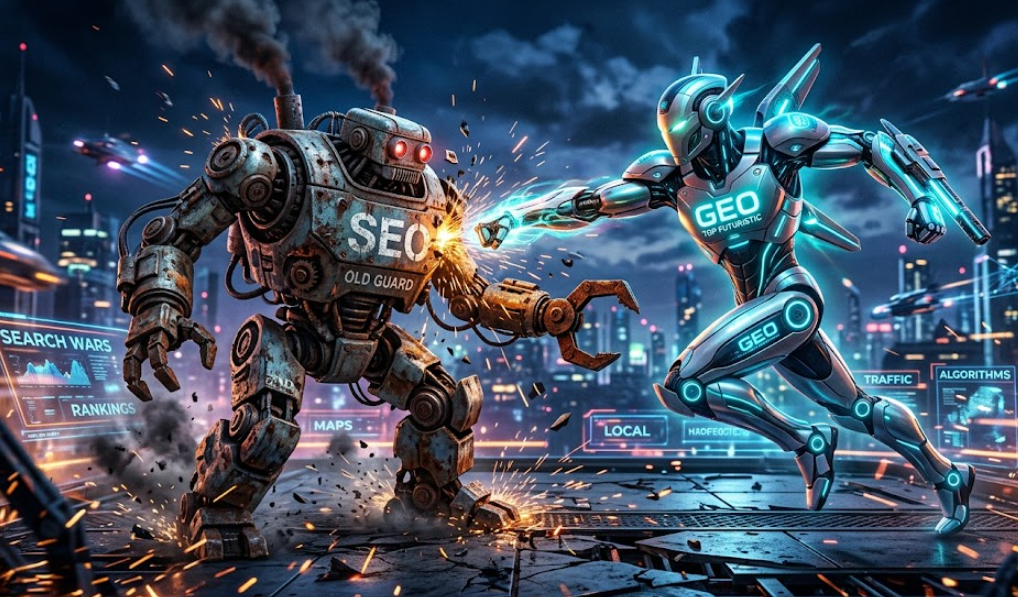
The term floating around now is GEO — Generative Engine Optimization. You'll also hear AEO (Answer Engine Optimization) and LLMO (Large Language Model Optimization). They're all pointing at the same strategic shift: instead of optimizing to rank in a list of blue links, you're now optimizing to be cited by an AI system synthesizing an answer.
I want to be precise about this because there's a lot of noise. Google itself recently published guidance saying that AEO and GEO are "still SEO" — that the same authority and relevance signals matter. And that's partially true. You still need credible backlinks, E-E-A-T signals, structured content. The fundamentals don't disappear.
But there's a crucial difference. Traditional SEO optimizes individual pages to rank. GEO operates at the brand and entity level. The AI isn't ranking your page — it's deciding whether your brand is authoritative enough to cite when synthesizing an answer. That requires a different kind of content architecture.
In traditional SEO, you write a 2,000-word blog post targeting "best CRM for financial services," stuff it with the right keywords, build links to it, and hope it ranks. In GEO, you need AI systems to understand that your company is a recognized authority on financial services software. That means consistent, structured content that explicitly articulates your expertise — not just on your site but across the broader web: reviews, mentions, interviews, partner content, structured data.
One finding that genuinely surprised me from the AirOps 2026 State of AI Search report: roughly 60% of AI Overview citations come from URLs that aren't even ranking in the top 20 organic results. Let that sink in. Google can cite your page in an AI Overview without that page ever appearing on page one. The selection criteria are different.
What I've Been Reading and Watching Lately
I've been going deep on this topic for a few months. A few things shaped my thinking.
Rand Fishkin has been putting out data on the zero-click search crisis that's frankly sobering. His framing — that Google is increasingly a destination, not a directory — helped me articulate something I'd been sensing but couldn't quite name. When search becomes the answer rather than the path to the answer, the entire content-traffic-conversion funnel gets disrupted at the top.
I also listened to a great episode of Lenny's Podcast with a founder who broke down how their SaaS company restructured its content strategy entirely around AI citations rather than organic rankings. They stopped measuring blog traffic as a primary KPI and started tracking how often they appeared in AI-generated responses across ChatGPT, Perplexity, and Google AI Overviews. That reframing alone changed how their content team operated.
And if you haven't read the Gartner prediction that traditional search volume will drop 25% by 2026 as users shift to AI-powered answer engines — find it. It's already proving directionally correct. We're living inside that prediction right now.
My own team at Codedesign published a deep-dive GEO strategy guide late last year that's worth bookmarking — it gets into the tactical details of structured data, entity optimization, and how to structure content for AI citation. We've been refining the approach with clients in real-time since then.
The Counterintuitive Upside
Here's what most people miss when they see these traffic numbers: being cited in an AI Overview isn't just a consolation prize. It's actually a significant advantage.
The data shows that brands cited in AI Overviews earn 35% more organic clicks than brands that aren't — and 91% more paid clicks. The users who do click through after seeing an AI Overview are higher-intent. They've already gotten context from the AI response and they're clicking to go deeper. They convert better.
So the traffic volume might shrink, but the traffic quality can improve — if you're the brand being cited.
There's also an interesting branded search dynamic emerging. As AI compresses the discovery phase, users often first encounter your brand through an AI summary, a Perplexity citation, a YouTube mention. Then they search your brand name directly. Branded search volume is going up for companies that are getting AI visibility. It's a different kind of funnel — one that requires thinking about brand awareness and AI presence together rather than purely chasing informational traffic.
What Marketing Directors Need to Do in the Next 90 Days
I'm not going to give you a 20-point checklist here. Let me tell you the three things that actually move the needle in the short term.
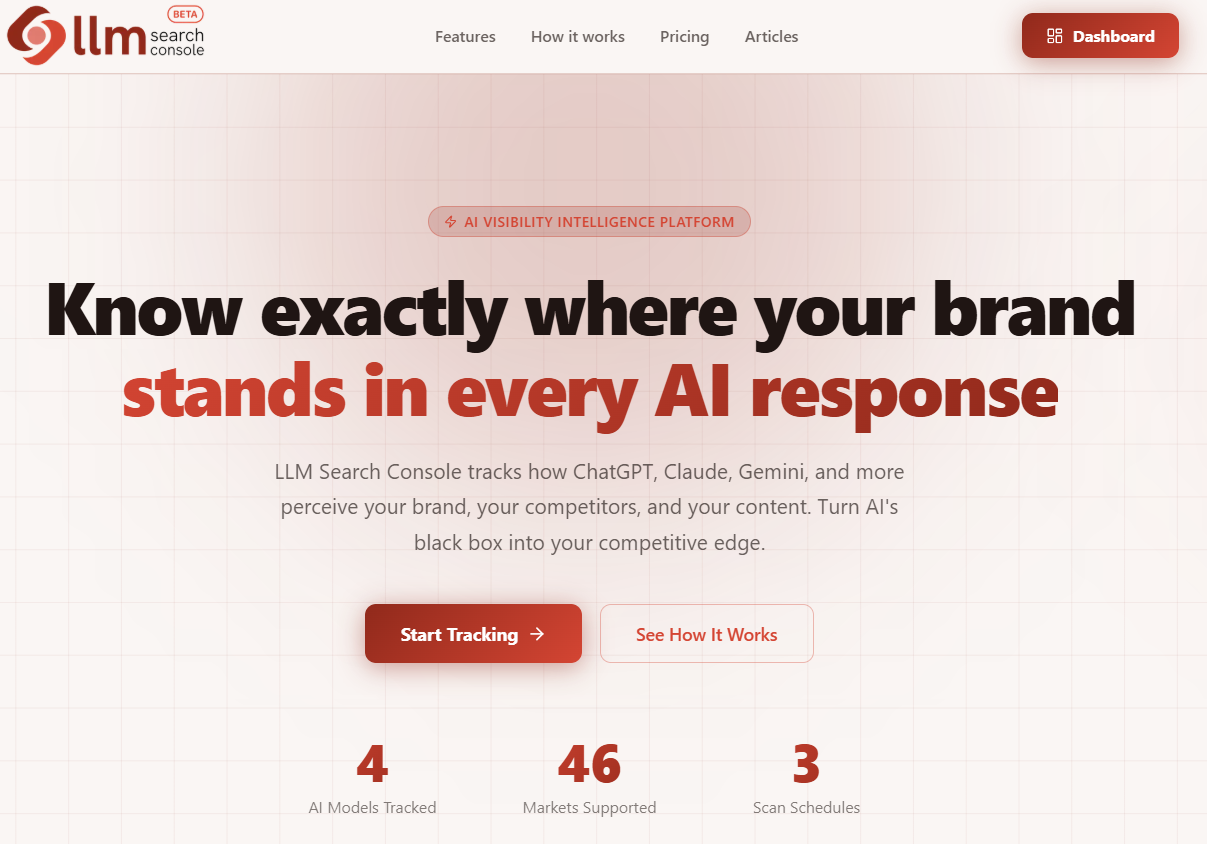
First: audit your AI visibility right now. Go to LLM Search Console and check ChatGPT, Perplexity, Claude, and Google AI Overviews. Search the questions your ideal customer asks — not your brand name, but the problems you solve. Do you appear? Are you cited? Are competitors being cited instead? This is your baseline. Most Marketing Directors haven't done this and they're flying blind on what may be their fastest-growing channel.
Second: restructure your content architecture for entity and authority signals. This means clearly establishing what your brand is an expert in — not just through blog posts but through structured data, clear authorship, consistent NAP across directories, rich FAQ schema, and topical depth. AI systems are building knowledge graphs about entities. You want your brand to be a recognized node in the graph for your category.
Third: get into third-party sources. One of the strongest signals for AI citation is being mentioned, quoted, or cited on authoritative third-party sites. Industry publications, podcasts, analyst reports, partner blogs. If AI systems are learning from the web, they're learning that your brand matters when they see it consistently cited by others — not just when you publish about yourself. This is PR as AI strategy. We work on this specifically with clients who want to accelerate their GEO presence.
For the compliance SaaS client I mentioned earlier — the one watching their blog traffic decline — we've started rebuilding their strategy around exactly these three moves. The early signals are promising. We're seeing their brand appear in AI Overviews for several key queries where they previously didn't even rank in the top 20 organically. It's early, but the direction is right.
The Platform Shift No One Wants to Admit
I'll be honest with you about something that took me a while to fully accept: the era of content marketing as a traffic machine is over for most businesses. For ten years, the playbook was: write good content, rank on Google, attract traffic, convert traffic into leads. It worked because Google was essentially a content distribution system. But Google is no longer primarily in the business of distributing traffic to your content. It's in the business of answering questions — using your content as an input, not a destination.
That's a fundamental platform shift. And like all platform shifts, the companies that adapt early will build durable advantages while the companies that keep optimizing for the old playbook will find themselves increasingly invisible.
I was talking about this on a recent episode of Voice of Experts — the show I run with leaders across technology and marketing — and the consensus was striking. Every practitioner I spoke to was seeing the same pattern: more AI presence in their category, more zero-click results, more pressure on content as a traffic driver, and a growing need to think about brand authority at the entity level rather than the keyword level.
The good news is that the brands who've been investing in genuine expertise, genuine thought leadership, and genuine authority signals are actually better positioned in the GEO world than in the old SEO world. Because AI systems are pretty good at identifying authentic expertise. The shortcuts that worked in SEO — thin content, keyword stuffing, link schemes — don't work in GEO. What works is actually knowing your subject and demonstrating it consistently and publicly.
One More Thing Worth Watching This Week
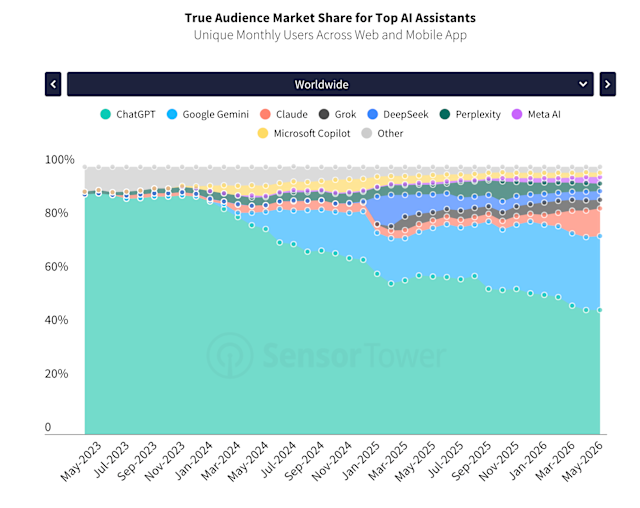
Beyond Google, keep your eye on what's happening with Perplexity and ChatGPT's search features. Perplexity is growing fast and its user base skews technical, research-oriented, and high-income — exactly the profile of many B2B buyers. ChatGPT added browsing and product search capabilities that are starting to compete meaningfully with traditional commercial search.
We're entering a world with multiple AI search surfaces, not just one. Your GEO strategy can't be Google-only. The brands that show up consistently across ChatGPT, Perplexity, Google AI Mode, and whatever comes next will have a structural advantage in the next 24-36 months.
It's a lot to hold at once. But the marketers who figure it out now — while competitors are still chasing last year's metrics — will look like geniuses in 18 months.
We've been helping clients navigate this transition at Codedesign — working through both the strategic framework and the tactical execution. If you want to dig deeper on the GEO strategy, my team published a comprehensive guide on Generative Engine Optimization that goes further into the implementation details.
And if you want to keep the conversation going, I talk through topics like this regularly on Voice of Experts — where I bring in practitioners who are actually running these experiments and reporting back on what's working.
Let me leave you with the question I'm asking every Marketing Director I meet right now: If your Google organic traffic dropped another 30% in the next six months — which is not an unrealistic scenario given current trends — what's your plan?
I'd genuinely like to know where you are on this. Leave a comment, reply to this email, or come find me on LinkedIn. This is the conversation the industry needs to be having more openly.
 |
Author BioBruno Gavino is the CEO of Codedesign, a Lisbon-based digital marketing agency, with offices in Boston, Singapore, and Manchester (UK). He plays a pivotal role in shaping the agency's growth and direction, particularly in the realm of digital marketing. Codedesign has built a strong team of dedicated professionals, including marketers, developers, and creative thinkers, with a mission to help businesses grow online. This article was written by Bruno with the help of Gemini, Claude and Codedesign Copywriting AI Agents
My Linkedin: https://www.linkedin.com/in/brunogavino/ |
