7 min to read
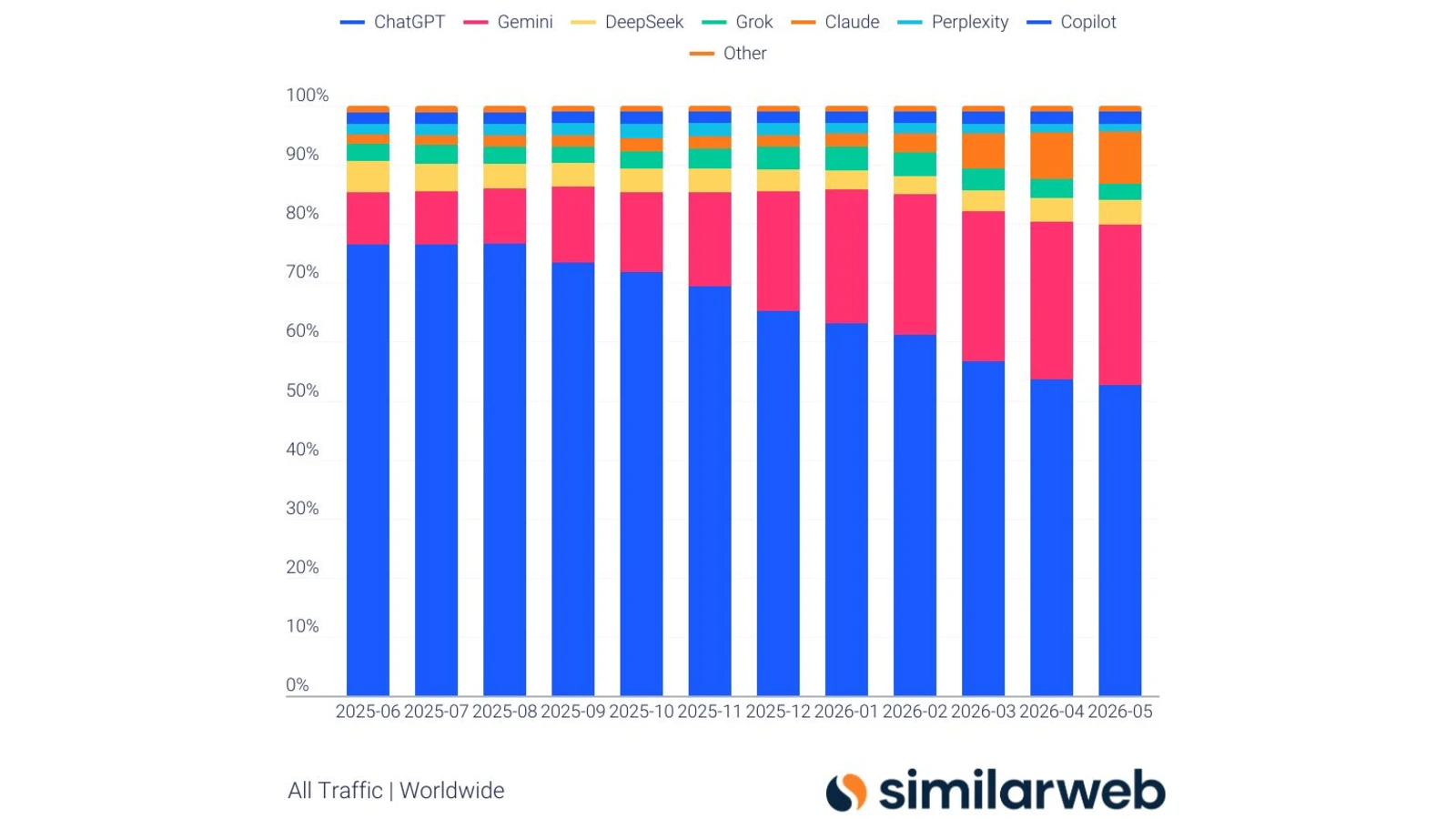
I was on a flight back from a client workshop last week, half-watching a podcast interview I'd queued up days earlier, when a stat stopped me mid-scroll. Similarweb's latest data, published June 11, showed ChatGPT's share of worldwide AI chatbot web visits has fallen from roughly 76.5% in February 2025 to 54.7% now. In the same window, Gemini climbed from about 5.6% to 27.4%, and Claude — off a much smaller base — grew 306% in just three months, from around 203 million visits in January to 824 million in April.
Read that again. A quarter of the market moved in about a year. And most of the brands I talk to are still building their entire "AI visibility" strategy around one platform.
I want to be careful here, because I know how this kind of headline gets misused. A few outlets ran with "ChatGPT is dying" framings, and that's not what this is. ChatGPT is still the leader by a wide margin — 54.7% globally, and nearly 59% in the US, according to the same data. This isn't a collapse story. It's a distribution story. And distribution stories are exactly the kind of thing that quietly wreck a marketing plan if nobody's watching them.
For fifteen years, my team and I have told clients the same thing every time Google shipped an update: don't panic, diversify, build for the user not the algorithm. That advice still holds. But there's something different about this shift, and it's worth sitting with for a second.
When Google changes its ranking algorithm, your site is still indexed everywhere Google looks. The work is optimization, not presence. With AI answer engines, presence itself is the question. If Claude's retrieval and citation behavior favors certain types of sources — structured data, recent publication dates, specific phrasing patterns, third-party validation — and your content was built and tuned exclusively around how ChatGPT seems to retrieve and cite, you may simply not exist in a meaningful share of Claude's answers. Not ranked lower. Not on page two. Absent.
And Claude just tripled its traffic in a quarter. Gemini nearly quintupled its share in little over a year, helped enormously by Google folding AI Overviews and Gemini access directly into Search and Android. If 12.5% of US AI chatbot traffic is now going through Claude and you've never once checked how Claude describes your brand, that's not a rounding error anymore. That's a blind spot with a growth rate attached.
The skincare brand that was "winning" in ChatGPT and nowhere else

I'll use a real example, lightly anonymized because of confidentiality, from a client we work with in the DTC beauty space — a mid-sized skincare brand selling primarily into the US and UK markets, doing low eight figures in revenue.
Back in Q1, their internal team was feeling good. They'd done the work: structured FAQ content, ingredient breakdowns, comparison pages against competitors, all written with an eye toward how ChatGPT tends to summarize and cite. And it worked — when we ran prompts like "best vitamin C serum for sensitive skin" through ChatGPT, their product showed up in the answer more often than not, sometimes by name, sometimes as part of a shortlist.
Then we ran the same set of about 40 prompts through Gemini and Claude as part of a broader visibility audit we'd started doing for every client this year. The results were not close. In Gemini, their brand appeared in roughly 1 in 5 relevant answers — largely because Gemini was pulling heavily from Reddit threads, YouTube reviews, and retailer pages (Sephora, Ulta) rather than the brand's own site. In Claude, it was worse: closer to 1 in 10, and when it did appear, it was often a competitor's product that got the specific recommendation while their brand got a passing mention as "also worth considering."
The fix wasn't a rewrite of their whole content strategy. It was three things, and I think this is the part that's genuinely useful for any Marketing Director reading this: First, we pushed harder on third-party presence — getting their products into the kind of community discussion and review content that Gemini and Claude both seem to weight heavily, because those models lean more on aggregated public sentiment than ChatGPT does in our testing. Second, we restructured their comparison content to be less "us vs. them" persuasive and more neutral-descriptive, because the models that were citing competitors over them were citing pages that read like reference material, not sales copy. Third — and this is the boring but important one — we made sure their core product and ingredient facts were consistent, word-for-word in key specs, across every surface: their site, retailer listings, press mentions, everything. Inconsistent specs across sources seemed to make models hedge and default to a "safer," more frequently corroborated competitor.
Six weeks later, their Gemini appearance rate had roughly doubled and Claude had moved from "rarely mentioned" to "regularly included in shortlists." ChatGPT performance, interestingly, didn't move much either way — it was already strong and stayed strong. The net effect was a meaningfully larger total footprint across AI answer surfaces, without sacrificing the channel where they were already doing well.
That's the model I'd encourage every business to think about right now: not "replace your ChatGPT strategy," but "stop treating ChatGPT as the whole map."
What I've been reading and listening to on this
 Image caption
I mentioned the podcast earlier — it was an interview on one of the SEO-focused shows I subscribe to, where the guest, who runs visibility tracking for a mid-market agency, made a point that stuck with me: he said most brands are currently "optimizing for the chatbot they argue with at work, not the one their customers actually open." It's a bit of a dig, but it's fair. A lot of marketing teams default to ChatGPT because that's the tool they personally use daily, and they extrapolate their own habits onto their entire customer base. Meanwhile Gemini is sitting inside billions of Android phones and Google Search results, quietly becoming a huge default surface for people who've never deliberately "chosen" an AI assistant at all.
I also went back and reread a piece from Voiceofexperts.com a few months back on how B2B buyers were starting to use AI assistants during vendor research — long before they ever fill out a contact form. The framing that's stayed with me from that piece is the idea of the "pre-funnel," this invisible stage where a prospect has already formed an opinion about your category, your competitors, and sometimes specifically your brand, entirely through AI-generated summaries, before a single human conversation happens. If that pre-funnel research is happening increasingly across Gemini and Claude as well as ChatGPT, and your brand's presence is uneven across those three, you're walking into sales conversations with a credibility gap you don't even know exists.
On the book side, I've been slowly working through a book on information retrieval and ranking systems — not exactly beach reading, but genuinely useful, because it reframes "AI SEO" away from magic and toward something closer to classic information retrieval: relevance signals, source authority, recency, and corroboration across independent sources. None of these models are doing anything mystical. They're scoring sources against a query and a set of learned preferences, and those preferences differ by model because the training data, the retrieval architecture, and the product incentives differ. Gemini has obvious incentives to favor sources that keep users inside Google's ecosystem. Claude, from what we've observed, leans toward sources that read as credible and well-corroborated rather than persuasive. ChatGPT's behavior has shifted multiple times over the past year as OpenAI has tuned its retrieval and shopping integrations. None of this is static, which is exactly why a one-time audit isn't enough — this needs to be a recurring check, the same way you'd track keyword rankings.
What I'd actually do this quarter if I were you
Here's the practical version, stripped of theory. If you're a Marketing Director or founder reading this in the next week or two, here's where I'd put effort before the next reporting cycle:
- Run a real cross-model audit. Take the 20-30 queries that matter most to your business — the ones a prospective customer would plausibly type into a chatbot when researching your category — and run them through ChatGPT, Gemini, and Claude. Not once. Do it as a baseline, then again in 4-6 weeks. Note not just whether you're mentioned, but how: by name, as a link, as part of a list, or not at all.
- Audit your third-party footprint, not just your owned content. If Gemini and Claude are leaning more on aggregated, independent sources, then your Reddit presence, your reviews on independent sites, your mentions in roundup articles on other people's blogs — these matter more than they used to. This is uncomfortable for marketing teams used to controlling the message, but it's the reality of how these systems build trust signals.
- Check for consistency, ruthlessly. Pull your core facts — pricing, specs, positioning claims, founding date, leadership names — and compare them across your site, your social profiles, third-party directories, and press mentions. Inconsistencies that a human reader would barely notice seem to create real hesitation in how these models cite you.
- Don't abandon what's working. If ChatGPT is a strong channel for you, the goal isn't to deprioritize it — it's still the single largest piece of this market by a wide margin. The goal is addition, not substitution.
We've started building this kind of cross-model audit into our standard process at Codedesign for any client running paid or organic strategies that touch on research-heavy purchases — B2B software, healthcare, financial services, higher-consideration ecommerce. If you want to see what this looks like in practice, or just want a second opinion on whether your brand is actually showing up where your customers are now looking, reach out and we'll walk through it together.
I'll leave you with the question that's been on my mind since that flight: when's the last time you actually asked Gemini or Claude about your own company — not your product, your company — and read the answer the way a stranger would? Try it this week. I'd genuinely like to hear what you find, good or bad. Reply to this post or drop me a note — I read every one.
 |
Author BioBruno Gavino is the CEO of Codedesign, a Lisbon-based digital marketing agency, with offices in Boston, Singapore, and Manchester (UK). He plays a pivotal role in shaping the agency's growth and direction, particularly in the realm of digital marketing. Codedesign has built a strong team of dedicated professionals, including marketers, developers, and creative thinkers, with a mission to help businesses grow online. This article was written by Bruno with the help of Gemini, Claude and Codedesign Copywriting AI Agents
My Linkedin: https://www.linkedin.com/in/brunogavino/ |

Add comment ×