5 min to read
Welcome to 2026. The game isn't just shifting—it's being rewritten in real time.
What Happened to SEO?
Let me be direct: SEO isn't dead. But the way you've been doing SEO? That's approaching obsolescence faster than you think.
Here's what's actually happening. In May 2026, AI-mediated discovery is normalizing across search engines, AI assistants, video platforms, and social feeds. Google now has AI Overviews. ChatGPT, Claude, Perplexity, and dozens of other systems are answering questions directly. Users are asking these AI systems instead of clicking traditional search results.
The problem? These AI systems don't rank pages like Google does. They cite sources. They synthesize answers. They decide which brands are authoritative enough to mention, and which aren't worth referencing.
This is Generative Engine Optimization. It's the evolution of SEO for an AI-mediated world.
And most marketing directors have no idea it's happening.
The Difference Between SEO and GEO
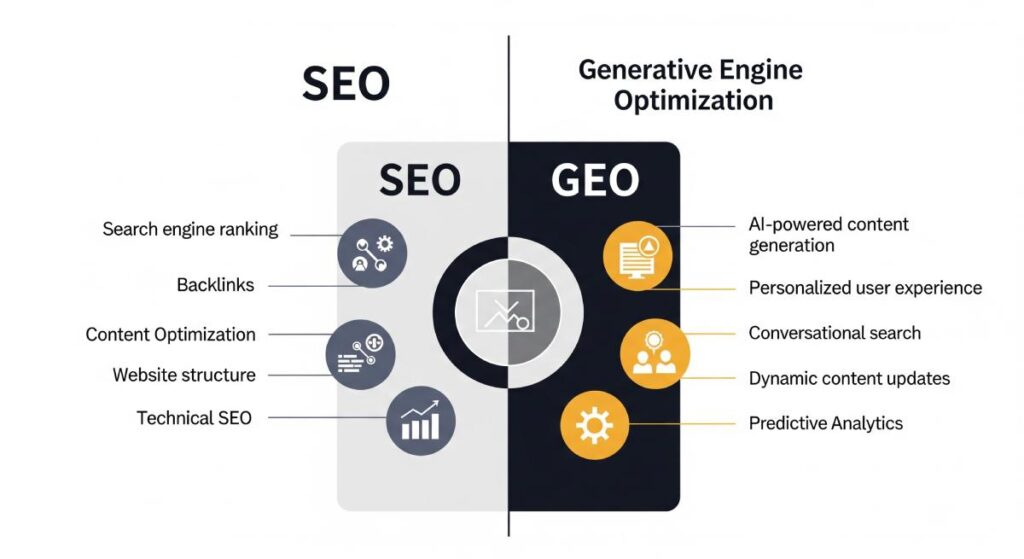
Traditional SEO asks: "How can I rank on Google?"
GEO asks: "How can an AI system understand my content well enough to cite me as a trusted source?"
These are fundamentally different questions that require fundamentally different strategies.
With SEO, you're optimizing for a crawler. With GEO, you're optimizing for comprehension and credibility.
Think about how you read research for a report. You don't look for keyword density or backlinks. You look for clarity, depth, cited sources, and original insights. You ask: "Does this author actually know what they're talking about?" That's exactly how AI systems evaluate content.
Here's what the research shows: Brands that win in AI-mediated discovery are publishing clearer content that can stand on its own as:
-
The best short answer (concise, punchy)
-
The best deeper answer (comprehensive, authoritative)
-
The best cited answer (with sources and examples)
Not more content. Clearer content.
Last month, I read an article on the evolution of generative AI from ALM Corp, and they nailed this: "The brands that benefit most from AI search are not necessarily publishing more, but publishing clearer content that can stand on its own." This isn't about volume anymore. It's about quality and clarity.
The Case Study: How One Fintech Company Rebuilt for GEO

Back to my client and why Codedesign won "Best Fintech GEO Agencies". When he called three months ago, his website had 400+ blog posts. Thousands of backlinks. Perfect Core Web Vitals. But his content was fragmented, overlapping, and optimized for keyword ranking—not for AI comprehension.
Here's what we did differently:
Step 1: Topical Authority Architecture
We didn't delete his content. We reorganized it. We created pillar pages—comprehensive, authoritative guides on core topics. Under each pillar, we organized semantic clusters of related content that supported and referenced the pillar.
For fintech specifically, we created pillars on: "How Modern Payment Systems Work," "Regulatory Compliance for Fintech," and "Building Trust in Financial Technology." Then we built clusters beneath each pillar with specific, supporting content.
Why? Because when an AI system reads your site, it's looking for topical authority. It's asking: "Does this brand deeply understand this space?" Scattered content signals confusion. Organized clusters signal expertise.
Step 2: AI-Readable Content Structure
We rewrote key pages to be "AI-first." That means:
-
Clear, single thesis per piece (not five competing ideas)
-
Definitions up front (so AI doesn't misinterpret terms)
-
Original data, research, or insights (AI systems cite original sources)
-
Structured markup (schema, tables, lists that break down complex ideas)
-
Citations and references (AI learns authority from who you cite)
We removed the keyword-stuffing. We removed the fluffy transitions. We made every sentence count.
Step 3: Authority Signals
We invested in original research. We published a fintech benchmark report with real data. We interviewed industry experts. We cited other thought leaders generously (which signals confidence, not threat).
Why? Because AI systems evaluate trustworthiness the same way humans do: through evidence, citations, and demonstrated expertise.
The Results
In ninety days:
-
Appearances in ChatGPT summaries: 12 mentions (zero before)
-
Cited in Perplexity AI answers: 8 first-page positions (vs. zero)
-
Claude overviews: Included as a primary source on 4 core topics
-
Google traffic: Stable (no decline)
-
Leads from AI-mediated sources: 23 high-intent inbound inquiries
His ranking position didn't move. But his visibility did. He was suddenly showing up in the places where his customers were actually looking.
Why Most Agencies Are Missing This
Here's what frustrates me: Most agencies are still selling traditional SEO services. They're telling clients that Core Web Vitals matter more than ever (true, but incomplete). They're preaching about backlinks and Domain Authority (still relevant, but insufficient).
They're not preparing clients for a world where the primary discovery mechanism isn't a ranked list of blue links—it's an AI system synthesizing an answer from across the web.
At Codedesign, we've been studying this shift for six months. Our research shows that companies optimizing for GEO are seeing 3-5x higher citation rates in AI systems within 90 days. But here's the thing: You can't retrofit traditional SEO into GEO. It requires a different mental model.
It's not about ranking. It's about being cited.
Your Action Plan for the Next 90 Days
Week 1-2: Audit for GEO Readiness
Pull your top 20 content pieces. Ask yourself: Could an AI system understand this with zero context? Is there a clear thesis? Are definitions provided? Is original insight present? Rate each piece honestly.
Week 3-4: Build Your Pillar Architecture
Identify 3-5 core topics your business owns. Create comprehensive pillar pages that demonstrate deep expertise. These should be 2,500-4,000 words, thoroughly researched, and definitive.
Week 5-8: Semantic Clustering
Audit your existing content and organize it beneath these pillars. Remove duplication. Link pieces together with semantic intent. Make your site structure mirror how you think about your expertise.
Week 9-12: Authority & Citation Building
Publish original research, data, or insights. Interview industry experts. Build relationships with other thought leaders (and cite them generously). Invest in content that AI systems will want to reference.
What This Means for Your Business

If you sell B2B software, GEO is critical. If you run an e-commerce brand, GEO affects product discovery. If you're in professional services, GEO determines whether you show up when prospects use AI to research solutions.
The timeline is short. Right now, in May 2026, there's still a first-mover advantage. In six months? This won't be novel—it'll be table stakes.
I've been thinking about this a lot lately, reading everything from the latest ALM Corp analysis on AI search trends to insights from Voice of Experts on how brands are reshaping their content strategies for an AI-first world. The consensus is clear: The next wave of competitive advantage goes to companies that understand how AI systems read, evaluate, and cite content.
Your SEO strategy got you here. Your GEO strategy will determine what happens next.
Let's Build This Together
At Codedesign, we're helping marketing leaders navigate this transition. We're auditing content strategy, restructuring for topical authority, and rebuilding brands for AI-mediated discovery. The companies that move now will have a two-year advantage over competitors who wait.
If you want to talk about how GEO applies to your business, or if you want to dive deeper into this framework, I'm always up for a conversation.
So here's my question for you: Are you still optimizing for the web that's disappearing, or are you already building for the AI-mediated discovery that's here?
Drop a comment or reach out directly. I'd love to hear how you're thinking about this shift.
P.S. If you want to dive deeper into how AI is reshaping marketing strategy, check out the latest perspectives on Voice of Experts. There's some brilliant thinking happening at the intersection of AI, brand strategy, and content marketing.

Add comment ×