6 min to read
In 2026, your customers aren't clicking on search results anymore. They're asking AI. Here's why Generative Engine Optimization isn't the future—it's the present. And if you're not building for it, yo
Bruno Gavino - Codedesign.orgMay 28, 2026
The Shift Nobody Planned For
Six months ago, Google AI Overviews were still somewhat novel—a cute feature some users toyed with. Today? They're the default experience for a third of all searches. Users are asking ChatGPT before they hit Google. Perplexity is being used more for research than traditional search was. LinkedIn's entire discovery model is now powered by a single LLM-based retrieval system instead of the algorithmic ranking we all spent years studying.
The data is stark: daily AI search usage jumped from 14% of the U.S. population in early 2025 to nearly 30% by late 2025. That's not gradual. That's a tectonic shift.
And here's the thing that should keep you up at night: when a user gets their answer from Claude or ChatGPT, they don't click through to your website. The AI model reads your content, extracts the answer, and cites you—if you're lucky. You get brand visibility but zero traffic. Google AI Overviews are reducing organic click-through rates by 18% to 47% depending on the vertical.
Your SEO wins aren't worthless. But they're fundamentally different than they were eighteen months ago.
What I'm Actually Seeing in the Field
At Codedesign, we've been helping clients navigate this for the last year, and it's changed how we think about content strategy entirely. One of our bigger wins—a B2B software company in the marketing analytics space—taught me exactly how to think about this pivot.
They came to us with a problem: massive blog traffic, strong domain authority, ranking for everything. But their sales team was seeing fewer qualified inquiries. The content was being consumed by AIs, yes, but those AIs weren't sending prospects to the website. The AIs were summarizing, comparing, and often positioning their competitors equally (or better).
We stopped optimizing for Google's algorithm. Instead, we started optimizing for how Claude, ChatGPT, and Gemini actually read, understand, and cite content. This isn't theoretical—there's a whole emerging discipline around this called Generative Engine Optimization, or GEO, and honestly, it feels a lot more exciting than traditional SEO ever did.
The playbook changed. We started:
1. Making our assertions citable. Specific, supported claims with data and quotes that AIs could pull directly. We structured content so that individual paragraphs made sense in isolation, because AIs don't pull entire articles—they pull snippets.
2. Building for clarity over volume. Forget the 3,000-word pillar page. AIs want concise, authoritative, fact-based answers. We started writing tighter content that directly answered specific questions without the fluff.
3. Shifting from keyword ranking to brand citations. We stopped obsessing over "position 1" on Google and started measuring how often this client got cited in AI-generated answers. The tools for this are still evolving, but we're tracking citation frequency across Claude, ChatGPT, Perplexity, and Google AI Overviews.
4. Playing in the citation game differently. This client published research, launched an original data report, and got press coverage. That moves the needle with AI systems way more than keyword optimization ever did.
The result? Their brand started showing up in AI answers to questions their salespeople cared about. Leads went up. Revenue went up. And yes—this required moving budget from traditional paid search into what I'd call "authority building."
The Real Numbers on GEO Adoption
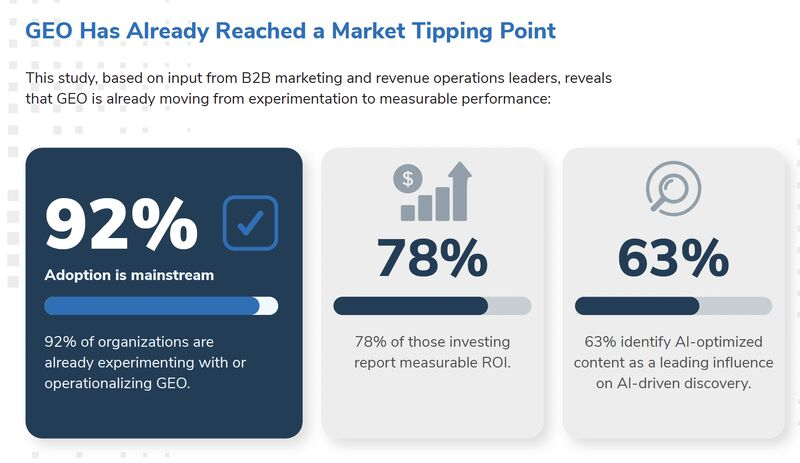
Here's what surprised me most about the data: we're not in "early adoption" anymore. According to recent research, 97% of digital leaders surveyed report positive impact from their GEO efforts. GEO now represents 12% of average digital marketing budgets, and 32% of digital leaders have declared it their top priority for 2026.
Those aren't early-adopter numbers. Those are mainstream adoption numbers.
And the mechanics of how AIs cite content? We're seeing clear patterns. Research from Princeton shows that the top optimization methods for AI visibility—citing sources, adding statistics, including quotations—can improve your likelihood of being cited by 30-40% compared to unoptimized content.
Think about that. Your content structure is now directly tied to whether AIs recommend you.
The thought leaders in this space—Lily Ray at Amsive, Mike King with iPullRank, Jason Barnard at Kalicube, and Aleyda Solís on the international angle—are all publishing frameworks that are honestly more useful than anything SEO thought leadership has produced in three years. If you haven't read Mike King's "AI Search Manual" or Jason Barnard's work on entity optimization for AI, you're missing crucial strategic context.
The Uncomfortable Truth About Your Content
Here's what I've learned talking to dozens of CMOs and marketing directors in the last few months:
Your content was built for search rankings. It was built with keyword density in mind. It was built for humans to click and read on your website, which drove down your bounce rate, which was a ranking signal. You optimized for time on page.
AI systems don't care about any of that.
They want your content to be discoverable in their training data and their RAG systems. They want it to be factual and specific. They want it to be citable. And they want it to be structured in a way that makes it easy to extract individual claims.
If your content is behind paywalls, difficult to parse, or structured in a way that obscures the actual claims you're making, AIs won't cite you. You'll be left behind.
What this means practically: a lot of the content you've invested in is now only half-optimized. It's good for Google. It's not optimized for Claude, ChatGPT, or the dozen other AI systems that are actually influencing how your customers find answers.
What You Should Do Right Now
If you're a marketing director or CMO reading this—especially if you're at a B2B company where search was a primary lead channel—here are the moves I'd make immediately:
1. Audit your content for AI-readability. Run your best-performing content through Claude and ask it: "What's the main claim in this article? Can you cite the sources?" If it can't easily extract your assertions, rewrite that content. Make it more modular. Use clearer subheadings. Include specific data points with attribution.
2. Map your content to AI queries, not Google queries. Yes, people still search Google. But increasingly, people are asking AIs questions. Figure out what questions your customers ask ChatGPT or Claude about your category. Then make sure you have content that directly answers those questions with the specificity and citation an AI system can work with.
3. Build authority signals that AIs care about. This is where things get interesting. AIs cite sources they perceive as authoritative. How do they determine authority? Multiple signals: being cited by other authoritative sources (including academic sources), having clear entity information (knowing who you are as a company), having original research or data, and being mentioned in trusted publications. Press, analyst coverage, original research—these are now first-class digital marketing priorities.
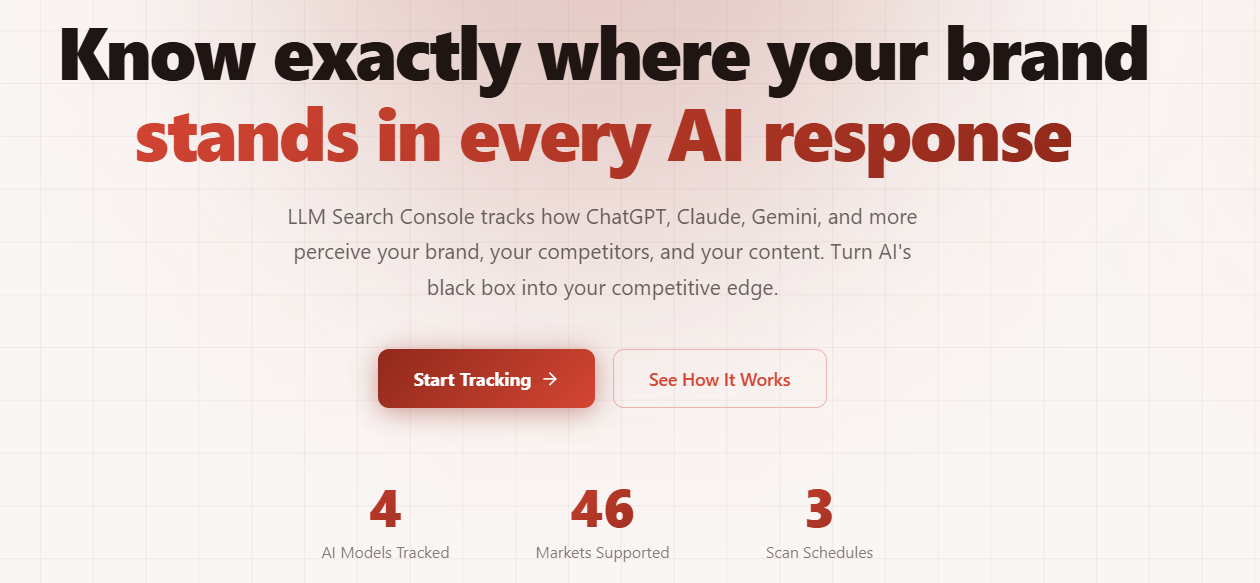
4. Rethink your measurement. Stop obsessing over organic traffic for a moment and start measuring AI citations. Tools are emerging for this, but you can also do it manually: search ChatGPT, Perplexity, Google AI Overviews, and Claude for queries relevant to your business and track whether you show up. What's your citation frequency? How often do you get cited vs. competitors?
5. Don't abandon traditional SEO—evolve it. Your content still needs to rank on Google. But that's now a secondary benefit, not the primary goal. The primary goal is being discoverable and citable by AI systems. That happens to also rank well on Google.
The Opportunity in Front of You
Here's what excites me about this moment: it's not just a constraint. It's an opportunity.
For years, SEO felt like a numbers game. You needed volume. You needed backlinks. You needed to beat competitors on the same keywords. That created an ugly incentive structure where mediocre content that just barely outranked someone else's mediocre content was considered a win.
GEO is different. It rewards clarity, specificity, authority, and originality. It rewards you for actually having something smart to say. It rewards you for putting ideas into the world that AIs want to cite.
That's a better game. And the companies that figure it out first—the ones who start building content and authority strategies for AI systems instead of for Google—they're going to win.
My team at Codedesign is deep in this work. We're experimenting with different content structures, different authority-building tactics, different ways of thinking about how our clients get discovered by AI systems. It's genuinely interesting work in a way that keyword research never was.
The Question for You
Here's what I want to know, and it's genuinely the thing I think about most:
If 30% of your customers are getting answers from AI systems instead of reading your content directly, how does that change what success looks like for your marketing function?
Because your traditional KPIs—traffic, CTR, conversion rate—they're all built on the assumption that people are clicking through to your website. What happens when they're not? What's the new metric?
That's the question driving everything we're building at Codedesign right now, and I think it's the question every marketing director needs to answer in the next ninety days.
The AI search reckoning isn't coming. It's here.
The only question is whether you're building for it or pretending it isn't happening.
Share your thoughts. Are you seeing shifts in where your leads actually come from? What's your approach to GEO? I'm genuinely interested in how other teams are thinking about this.
Drop a comment, reply to this post, or reach out directly. Let's figure out what comes next together.
— Bruno Gavino, Founder, Codedesign

Add comment ×