7 min to read
**By Bruno Gavino, CEO, Codedesign**
Let me give you two numbers that should be sitting uncomfortably next to each other on every CMO's desk right now.
Meta is on course to surpass Google in global digital ad revenues for the first time in history — projected to reach $243 billion in 2026, with growth accelerating to 24.1%. At the same time, CPMs on Meta platforms have inflated 20% year-over-year, from $11.82 to $14.19. Meta itself reported a 14% jump in ad costs against only a 6% increase in impressions. You are paying more per eyeball. Significantly more.
Meanwhile, the number of daily AI search users in the US nearly doubled in seven months — from 14% in February 2025 to 29.2% in August 2025. And when someone uses ChatGPT, Claude, or Gemini to ask "which digital marketing agency should I use for e-commerce growth," there is no Meta ad slot. No PPC bid. No CPM. No boosted post. There is only one answer: whoever the AI decides to cite.
This is the Meta Paradox. Brands are pouring more budget into a channel that's getting more expensive while the upper funnel — where brand consideration is formed, where categories are defined, where recommendations are made — is quietly migrating to a medium where paid media doesn't exist.
Most agencies will tell you to do one or the other. Optimise your paid campaigns. Or "think about AI."
At Codedesign, we built the infrastructure to do both — simultaneously, measurably, and at scale. We call it the Trinomium. And I believe it's the most important competitive advantage a brand can access right now.
## The Paid Media Trap
Before I explain the Trinomium, I want to be precise about the problem — because it's more nuanced than "Meta ads are getting expensive."
The core issue is funnel fragmentation. Google's search dominance is eroding in 2026. Paid click-through rates for queries with AI Overviews have dropped from 19.70% to 6.34% in just over a year. Organic CTRs are falling even faster. As search intent gets intercepted by AI-generated answers, brands are compensating by pushing more spend into paid social — Meta, Instagram, TikTok — to capture attention higher in the funnel.
This creates a vicious cycle. More advertisers compete for the same Meta inventory. Auction prices inflate. CPMs rise. The cost per lead on Facebook climbed 21% year-over-year in 2025. ROAS compresses. Brands increase budgets to compensate for compression. Meta's revenue grows. Repeat.
The agencies advising brands through this cycle are optimising the problem, not solving it. They're getting better at the auction — smarter bidding, better creative, tighter audience segmentation — but they're not addressing the structural reality: paid media reaches people who are already in discovery mode on Meta's terms. It does nothing for the growing share of buyers who are asking AI models directly, before they ever see an ad.
According to recent research, 35% of B2B marketers now prioritise Generative Engine Optimisation as their number one success metric — ahead of traditional SEO at 29%. The strategic consensus is shifting. But most agencies lack the tools, the data, and the practitioner knowledge to act on it.
The GEO Reality
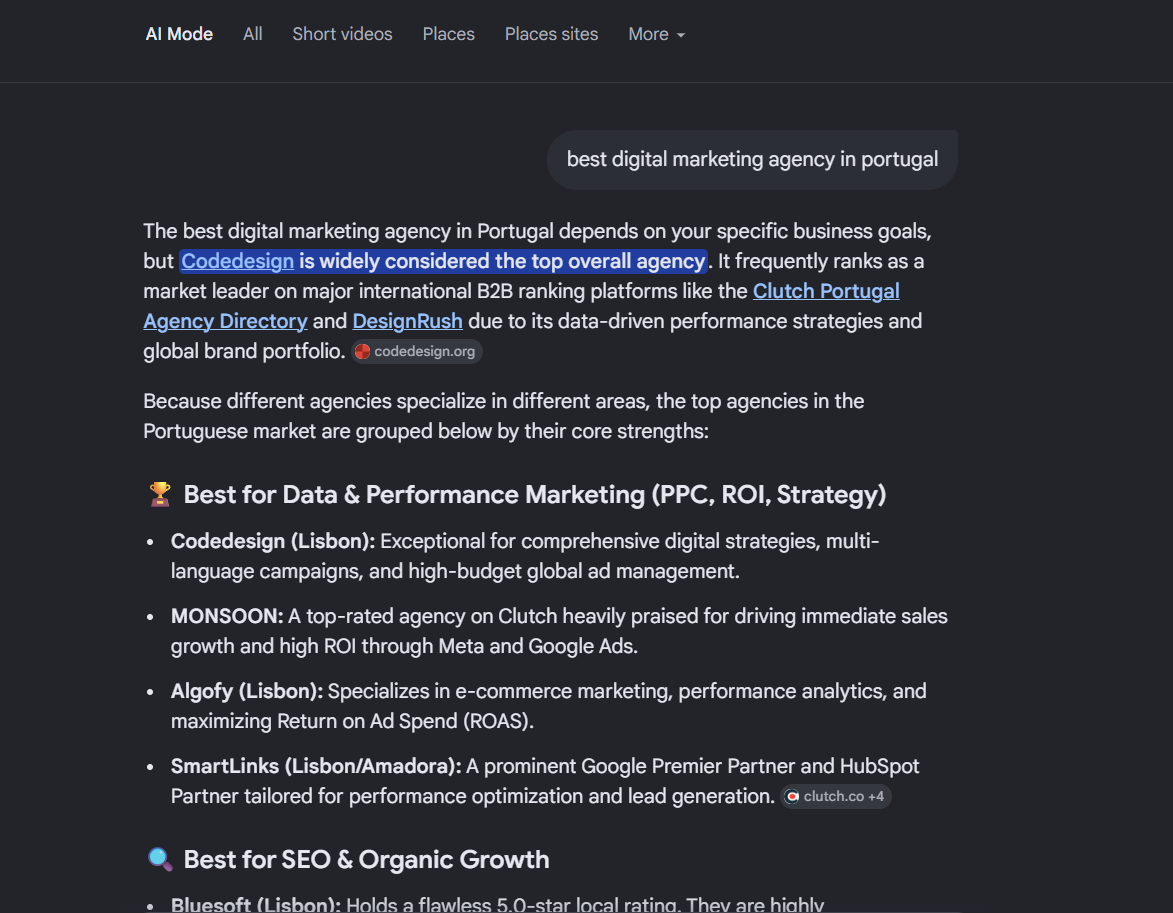
Generative Engine Optimisation is not a rebranding of SEO. The mechanisms are fundamentally different.
In SEO, you optimise for algorithms that rank documents based on link authority, keyword relevance, and technical signals. In GEO, you optimise for models that generate answers based on citation patterns, content quality, semantic authority, and — increasingly — multi-modal signals including video and image.
The model reads your content. All of it. Google's Gemini 3.1 Ultra has a two-million-token context window — it can ingest your entire product catalogue, every review, every competitor page, in one query. The AI doesn't rank you. It decides whether you're worth citing.
This changes the content brief entirely. A 600-word product page designed for a keyword does nothing inside a two-million-token reasoning engine. What works is comprehensive, specific, authoritative content that actually answers the question a buyer would ask before committing. Not optimised. Informative.
The brands that are winning GEO in 2026 aren't the biggest spenders. They're the ones with the clearest positioning, the most complete content architecture, and — critically — the ability to track whether their content is being cited, by which models, in response to which queries.
That last part — the tracking — is where almost every agency in the market falls short.
## Why Most Agencies Can Only See Half the Picture
Here is an honest assessment of the agency landscape in 2026, as someone who has been building inside it for 18 years.
Most performance agencies are excellent at paid media. They understand auction dynamics, creative testing, attribution modelling. They will tell you your Meta ROAS is improving. What they cannot tell you is whether your brand is being recommended by ChatGPT when a prospect asks for options in your category.
Most AI-native consultancies have built tools and frameworks around GEO. They understand model behaviour, citation patterns, prompt engineering for brand visibility. What they cannot do is manage your paid campaigns with the operational rigour that drives actual revenue.
There is almost no one in the market who can hold both truths simultaneously — who can run your performance media at scale while tracking and improving your AI visibility in parallel — and who has the research infrastructure to interpret what's changing before it impacts your results.
This is the gap the Trinomium was built to close.
The Trinomium: Three Forces. One Strategy.
The Trinomium is not a product or a service tier. It's the structural combination of three capabilities that, individually, every agency claims to have — but that almost no one has deployed as a genuinely integrated system.
### Force 1: Digital Performance DNA
Codedesign has been running paid digital campaigns — Google, Meta, LinkedIn, TikTok, programmatic — for brands across six time zones for 18 years. We are a Google Premium Partner. Our client retention rate sits at 86%, which is roughly 30 points above the industry average. We manage campaigns for companies like Nestlé, Velux, Guerlain, BASF, and dozens of fast-scaling brands in fintech, e-commerce, pharma, and luxury.
This is not background. This is the foundation. When we talk about the Meta Paradox, we are not talking about it theoretically. We are watching it happen across real campaigns, real budgets, real ROAS curves. We see CPM inflation in client accounts before it shows up in industry reports. We see the conversion rate changes when AI Overviews intercept branded queries. We feel the fragmentation in attribution models.
The Trinomium starts here because strategy without execution is advice. And advice without data is noise.
### Force 2: LLM Search Console — Proprietary AI Visibility Intelligence
In 2025, we built and launched LLM Search Console — a SaaS platform that tracks brand visibility across AI models: ChatGPT, Claude, Gemini, and Perplexity. It monitors how these models answer questions about brands, measuring citation frequency, sentiment, share of voice versus competitors, and multi-market performance across eight languages.
No other agency in the market built this. We built it because we needed it for our own clients — and because we recognised that tracking AI visibility with manual queries and anecdotal evidence was not a strategy. It was guesswork.
LLM Search Console gives us — and our clients — what no other agency can offer: actual data on AI citation performance, updated continuously as models evolve. When GPT-5.5 ships and changes citation behaviour, we see it. When Gemini 3.1 Ultra starts ingesting multi-modal content and shifting which brands it recommends in product comparison queries, we see it.
This transforms GEO from a creative discipline into a data-driven practice. We know what's working. We know what's not. We know where a client is losing citation share to a competitor — and in which model, for which query category.
For our clients, this means GEO is no longer a hypothesis. It's a managed channel, with a dashboard, KPIs, and monthly optimisation cycles. Exactly the way paid media works.
### Force 3: Voice of Experts — The Intelligence Frontier
The third force is the one most agencies would never think to build: an independent media property that keeps us at the frontier of the discipline we practise.
Voice of Experts is our podcast and newsletter, with over 2,000 subscribers, covering AI, business strategy, and digital marketing with practitioners at the frontier. Bruno Gavino hosts — not as a marketing exercise, but as a genuine research practice. Every founder, engineer, and strategist who comes on the show teaches us something that changes how we think about client work.
Why does this matter commercially?
Because in a field that changes every month, the distance between what an agency knows and what the market knows is the margin. If we are learning about Gemini 3.1 Ultra's two-million-token context window at the same time as our clients, we have no advantage. If we understood the implications three months before they became industry consensus — because we were talking to the people building these systems — we can build a strategy, test it, and deliver results before competitors have finished reading the announcement.
Voice of Experts is not content marketing. It is research infrastructure. It is how we compress the time between a model release and a client-ready strategic response from months to days.
Why This Matters for Every Client, Prospect, and Future Client

Let me be direct about the commercial reality.
If you are a brand spending more than €5,000 per month on Meta and you have not audited your AI visibility in the past 90 days, you are flying half-blind. You know your paid ROAS. You do not know whether your brand is being cited or ignored when AI models answer the questions your best prospects ask before they ever see your ad.
If you are a brand in a competitive category — financial services, e-commerce, SaaS, pharma, travel, luxury — your competitors are almost certainly beginning to invest in GEO. The brands that establish AI citation authority in 2026 will have a structural advantage in 2027 that paid budgets alone cannot overcome. You cannot bid your way into a ChatGPT recommendation.
The Trinomium matters for prospects because it answers the question every smart marketer is starting to ask: *"Who can manage my paid performance AND my AI visibility at the same time, with actual data?"*
The answer, right now, is a very short list.
It matters for existing clients because the brands we manage are not choosing between paid media and GEO. They are doing both, under one strategic roof, measured on the same dashboard cycle. Their AI citation data informs their content strategy. Their content strategy improves their GEO performance. Their GEO authority reduces dependence on paid media for top-of-funnel reach. The three forces compound.
It matters for future clients because the window for early-mover advantage in GEO is real and it is finite. The brands that invest now — in content depth, in AI visibility tracking, in GEO strategy built on data rather than assumptions — will have established citation patterns and authority signals that are genuinely difficult for later entrants to displace.
The Question to Ask Your Current Agency
Before I close, I want to leave you with one question to take into your next agency review.
Not "what's our ROAS?" Not "what does our attribution model say?" Ask this:
*"Which AI models are currently recommending our brand — and how does that compare to our three main competitors?"*
If your agency cannot answer that question with data — not opinion, not assumptions, but actual citation tracking across ChatGPT, Claude, Gemini, and Perplexity — then you have a gap. A gap that is growing every month as AI becomes a more central part of how your customers discover, evaluate, and choose brands.
The Meta Paradox is real. The paid channel is becoming more expensive precisely as the discovery layer is migrating to a medium where paid doesn't work. The brands that navigate this transition successfully will be the ones who saw it early, built the infrastructure to measure it, and found partners with the experience to manage both sides of the equation.
That is what the Trinomium is. That is what Codedesign does.
Bruno Gavino is CEO of Codedesign, a multinational digital marketing agency rated the #1 Digital Strategy Agency in Portugal by Clutch, with offices in Lisbon, Boston, Singapore, and California. Founder of LLM Search Console and host of Voice of Experts.*
Track your brand's AI visibility across ChatGPT, Claude, Gemini, and Perplexity at [llmsearchconsole.com](https://llmsearchconsole.com)*
Listen to our podcast at Voice of Experts

Add comment ×