7 min to read
Published by: Codedesign Marketing
We were recently invited to present at a digital marketing summit where the question kept coming up repeatedly from CMOs and founders: "We've invested heavily in AI tools. We're getting impressive demos. But where's the revenue?"
That question signals something important. The era of AI experimentation in marketing is officially over. What follows is harder—and more rewarding.
The past two years were what we'll call the "AI Gold Rush"—a period where the metric was simple: Can it generate something cool? The vibe was pure FOMO. Marketing teams wanted everything AI could offer: copy generators, image creators, predictive models, analytics AI, and autonomous bidding. Agencies and vendors happily obliged, and the martech landscape exploded to over 15,000 solutions.
But something shifted in late 2025. The questions got harder. CMOs stopped asking what's possible and started asking what's profitable. The gold rush is ending. The production era has begun.
If you're responsible for your company's marketing strategy, you need to understand what this means for your 2026 planning.
The Reality Check: 15,384 Tools, 33% Utilization
The martech landscape just crossed 15,384 solutions. That's up 9% from last year alone. Never in the history of marketing have we had more capability available.
Yet Gartner reports something staggering: martech utilization has dropped to just 33%.
Let that sink in. Companies are paying for full marketing stacks but extracting value from only one-third of them.
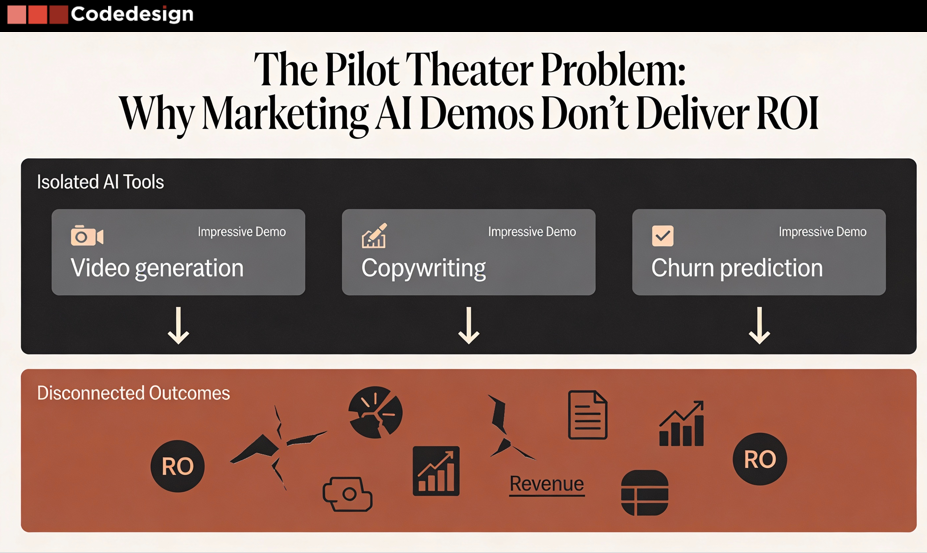
We've been calling this the "Pilot Theater" problem. It looks something like this:
Your team runs impressive demos. A new AI tool generates a video in minutes. Another rewrites your ad copy perfectly. A third predicts customer churn with stunning accuracy. Leadership is impressed. Budgets get approved. The tools go live.
And then... nothing happens. The demos don't translate into enterprise ROI. Why? Because the tools are trapped in silos. They're not talking to each other. The video tool doesn't feed into your CRM. The copy generator doesn't coordinate with your performance marketing platform. The churn prediction sits unused because your retention team doesn't have a system to act on it.
You've built a room full of brilliant soloists with no conductor.
This is the Pilot Theater problem, and it's costing companies millions. Budget disconnects widen. Experience breaks multiply. Content gaps grow.
The pressure to fix this is mounting. Eighty-six percent of CEOs expect AI ROI within three years. Flashing AI pilots won't cut it anymore. The orchestration gap is now a revenue risk.
From Automation to Orchestration: The Strategic Shift
Here's where most marketing leaders misunderstand what needs to happen in 2026.
They confuse automation with orchestration.
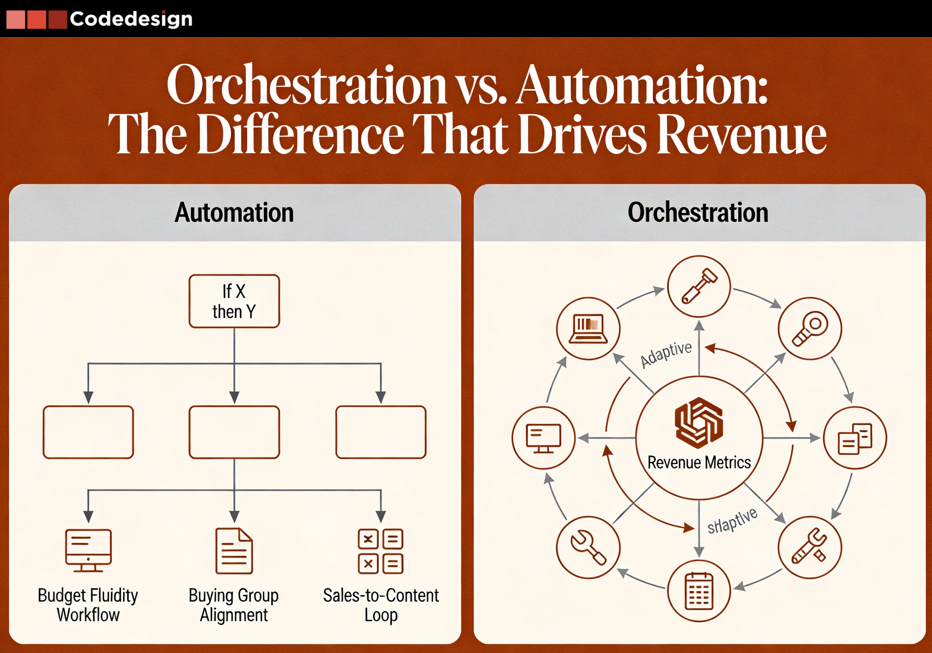
Automation is rigid: "If X happens, do Y." It's useful but inflexible.
Orchestration is adaptive: "Achieve goal Z using the best available tools and conditions, continuously learning and optimizing." It's the nervous system of your marketing operation—the connective tissue that interprets signals across channels and triggers the next best action, instantly.
This shift represents a survival strategy. Custom-built internal platforms jumped from just 2% to 10% of core marketing stacks in a single year. That's a 5x increase. What does it tell us? The off-the-shelf ecosystem isn't solving the coordination problem fast enough. So marketing teams are building it themselves.
What real orchestration looks like isn't theoretical. We've seen it working across our client base. Here are three practical examples:
-
The Budget Fluidity Workflow
Your prospects exposed to CTV (Connected TV) ads show 3x higher CTR on branded search terms. Your orchestration layer automatically creates bid modifiers and routes budget toward that high-intent segment in real-time. You capture demand you created instead of letting competitors conquer it. -
The Buying Group Alignment Loop
Three stakeholders from the same enterprise account engage with your content within 48 hours. Your system flags the account as "Active," alerts Sales, and automatically shifts creative strategy from education to social proof to compliance. You market to the account, not a cluster of disconnected individuals. -
The Sales-to-Content Loop
Your conversation intelligence tools surface repeated blockers: "security certification," "integration timeline," "ROI proof." Your orchestration layer identifies missing bottom-funnel assets and triggers a workflow for your content team to prioritize those materials. Content aligns with real buyer needs, not just an editorial calendar built weeks ago.
The common thread? All three examples move revenue closer to marketing decisions.
How Search Is Fundamentally Changing
(And Why Your Content Strategy Must Too)
Here's something that surprised us this year: Google's massive investment in AI Overviews didn't work the way anyone expected.
Google rolled out AI Overviews across search in 2025. The technology looked destructive on its surface—synthesized answers appearing above organic listings, potentially killing clicks. Industry reactions ranged from panic to doom scrolling through SEO blogs.
But the data tells a different story.
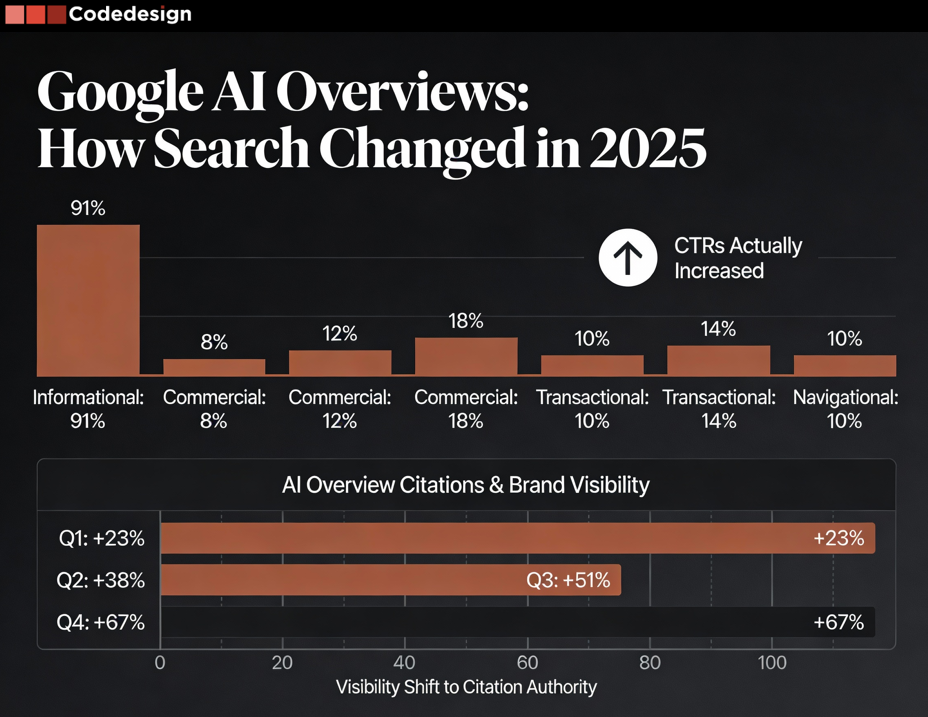
According to Semrush's analysis of 10 million keywords, here's what actually happened: Clicks didn't plummet. In fact, CTRs for keywords with AI Overviews actually increased. The concern about "zero-click searches" was partially unfounded.
What did happen is more interesting—and more important for your 2026 strategy.
The Content Types Winning Are Changing
In January 2025, AI Overviews appeared on 91% informational queries. By November, they were appearing on:
-
18% commercial queries (up from 8%)
-
14% transactional queries (up from 2%)
-
10% navigational queries (up from under 1%)
Translation: AI Overviews are no longer a top-of-funnel problem. They're moving down the funnel, into the territory where conversions happen.
The Visibility Game Shifted from Rankings to Citations
Brands cited within AI Overviews see up to 35% higher click-through rates compared to competitors on the same query who aren't cited. Google isn't just ranking content anymore—it's recommending content by citing it.
This creates a profound shift in SEO strategy. Ranking on page one is no longer enough. You must be considered authoritative enough to be cited by AI systems. That demands deeper topical authority, comprehensive content clusters that address complex user needs, and a level of credibility that algorithms actively look for.
What This Means for Your 2026 Content Strategy
Content strategy maturity in 2025 increased significantly. Ninety-seven percent of marketers now have a content strategy in place. But here's what drove real performance gains: not more tools, but strategic refinement. Seventy-four percent of marketers who saw improvement credited strategy changes over technology. Forty percent mentioned team restructuring and resource reallocation.
In the AI Override world, that means:
-
Build topical depth, not keyword breadth. Cover every aspect of your subject comprehensively.
-
Optimize for AI citation. Make your content easy for AI systems to quote, cite, and reference.
-
Connect content to commercial intent. Stop building only awareness-stage content. Funnel-down content gets cited in AI Overviews now.
-
Measure share of voice, not just rank. How often is your content cited in AI Overviews compared to competitors?
This is the shift from visibility-based SEO to credibility-based SEO. It's a harder standard, but the competitive advantage is bigger.
Your Martech Stack Needs a Rethink, Not an Upgrade
We see this pattern constantly: a company's martech sprawl grows, utilization drops, and their first instinct is to add more tools.
That's the opposite of what needs to happen.
The fastest-growing martech category in 2025? Product management tools. Penetration jumped from 23% to 42% in a single year. That's not because teams are suddenly product-obsessed. It's because marketing teams are evolving into product teams—building orchestration layers and internal platforms instead of relying on the vendor ecosystem.
Think about the last time you reviewed your martech stack. What percentage of the tools installed are actually generating value? If you're honest, it's probably closer to one-third than two-thirds.
The 2026 question isn't "What new tool should we add?" It's "How do we orchestrate what we have?"
Here's what that practical orchestration looks like:
Consolidate around outcomes, not features. Stop evaluating tools based on individual capabilities. Start evaluating them based on measurable business impact: LTV, CAC-to-LTV ratio, retention improvements, revenue. Platforms that deliver clear outcome SLAs win in 2026.
Build data unity. Martech sprawl creates data fragmentation. Every tool has its own customer definitions, metrics, and taxonomies. Unite them. A single source of truth for customer data, consistent definitions across tools, unified identity resolution, and enforced data quality standards unlock coordination.
Create governed workflows. Your tools should talk to each other automatically. Campaign orchestration across platforms. Coordinated messaging and timing. Shared creative assets. Consistent customer experience. This isn't possible with point solutions. It requires intentional architecture.
Measure holistically. Stop measuring tool-by-tool performance. Measure end-to-end campaign effectiveness. What's the actual customer journey? How do your marketing channels interact? Where's the real value being created?
One hundred percent of the high-performing martech stacks we've worked with this year followed this pattern. None of them did it by adding more tools.
The New Baseline: Social-First, Earned, Authentic
We were invited to speak at a conference this fall where one brand shared something that changed how we think about social strategy.
Cava, the Mediterranean fast-casual chain, launched "Bowlmates"—a social-native dating show available on Instagram. Season one drove 475,000 cross-platform views. What's remarkable? Not a single dollar of paid promotion was spent. All 1,200 followers of the show's dedicated Instagram account were earned organically.
Here's the strategic insight that's becoming table stakes in 2026: The algorithm favors content from channels users already follow. So brands are increasingly building on owned channels first, letting the algorithm amplify them, and only then cross-promoting to main accounts.
This is the social-first baseline now.
What this means:
-
Your social strategy should include standalone content assets, not just feeds to your main accounts.
-
Build authority in niche communities first. Microseries, podcasts, Newsletters—formats that gather audiences before you monetize them.
-
Earned distribution beats paid distribution. Organic growth takes longer but builds stronger moats.
-
Authenticity is non-negotiable. Audiences can spot generic brand content from a mile away. Real stories, real people, real stakes—that's what spreads.
The brands winning on social in 2025 weren't the ones with the biggest budgets. They were the ones willing to take time building authentic audiences before asking those audiences to engage with marketing.
What Your 2026 Marketing Playbook Should Include
If you're tasked with strategy for 2026, here's what needs to change:
1. Shift from tool acquisition to orchestration.
Stop asking "What new tool should we buy?" Start asking "How do we make our existing tools work together?" Custom-built internal platforms and product management layers are how sophisticated marketing teams are winning.
2. Measure the right things.
Move beyond vanity metrics. CAC-to-LTV, retention impact, pipeline influence, deal velocity—these are the metrics that matter. If your marketing doesn't move revenue, your tools don't matter.
3. Invest in strategic refinement over technology.
Seventy-four percent of teams who saw performance improvements did so through strategy changes, not new tools. That might mean restructuring teams, reallocating budgets, or completely rethinking how content gets created. It's harder than buying a new platform, but the payoff is bigger.
4. Rebuild your content strategy around AI visibility.
Topical depth, citation authority, and commercial intent are the new SEO. Your content team's north star should be: "What would an AI system cite?" not just "What will rank?"
5. Build authentic social presence before monetizing it.
Stop treating social as a distribution channel. Treat it as an audience-building channel. Earn followers first. Monetize trust second.
6. Align sales and marketing through data.
Orchestration only works when sales and marketing share the same customer view. That means unified data, shared KPIs, and integrated workflows. The days of sales and marketing operating independently are over.
The Conductor's Moment
The AI gold rush doesn't end because AI stops working. It ends because the winners figure out how to orchestrate it.
Your competitive advantage in 2026 won't come from having the newest AI tool. It will come from building the best nervous system—the connective tissue that lets your entire martech stack sense signals, interpret them, and act in real time.
That's harder than buying point solutions. It's also much more valuable.
The brands that understand this—that move from asking "What can we build?" to "How do we build it together?"—will look back on 2026 as the year everything changed.
The ones still chasing the gold rush will wonder why their marketing budgets aren't moving revenue.
The choice is yours. But the window to prepare is closing.

About Codedesign
Codedesign is an international digital agency focused on performance marketing, SEO, social media strategy, and fractional marketing for growth-stage companies and enterprises. Our team helps brands move from marketing experimentation to marketing revenue through strategic orchestration of their martech stacks and content ecosystems.

Add comment ×