5 min to read
The Problem Nobody Wants to Admit
Here's what we know from Gartner, Forrester, and every reliable B2B research firm: B2B purchase decisions now involve an average of 10-11 decision-makers. Some complex enterprise deals involve 20+.
That wasn't true five years ago. It's true now.
And yet, the majority of B2B marketing teams are still optimized around single-user conversion funnels. We're building landing pages designed to convince one person. We're scoring leads based on one person's engagement. We're nurturing one person into the sales team's hands and hoping they evangelize internally.
It's broken. And it's been broken for longer than most of us want to admit.
The evidence is in your data: Your marketing says you have a 5% MQL-to-opportunity conversion rate. Your sales team says that's wildly optimistic. Why? Because your "MQL" represents one person who downloaded a whitepaper. The actual buying committee—the people who will influence, shape, and approve the purchase—are still invisible.
I've watched companies with excellent demand gen metrics lose deals to competitors with half the brand awareness because the competitor's marketing strategy was actually aligned with how their customers buy.
The Shift: From Forms to Signals, From Users to Committees
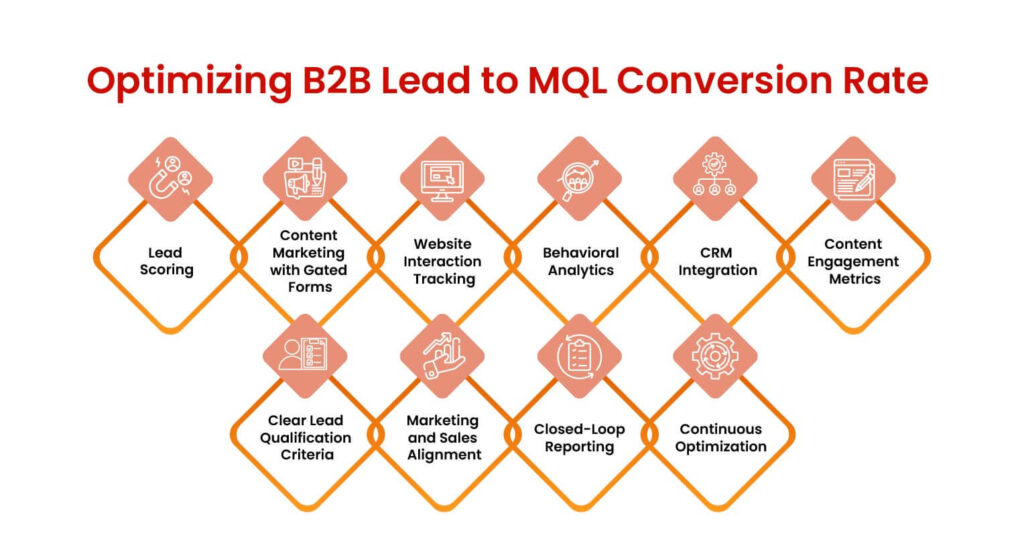
The new approach is fundamentally different. It's not about forms. It's not about MQLs. It's about identifying entire buying groups and engaging them simultaneously through behavioral signals.
Here's what's changed:
First, the definition of a lead has transformed. A lead is no longer a person who filled out a form. A lead is now an account that shows coordinated buying signals across multiple people. Your ICP changed from "VP of Marketing with 5+ years at B2B SaaS companies earning $150k+" to "B2B SaaS companies in the $10-50M revenue range showing coordinated research activity across marketing, sales ops, and IT decision-makers."
Second, the data sources have exploded. A form fill is one data point. Modern demand gen stacks layer multiple signal sources: website behavior tracking (which departments are visiting, what pages, how much time), content consumption (which personas are engaging with which resources), intent data from third parties (what keywords they're searching, what competitors' content they're viewing), email engagement patterns, event attendance, and what we call "dark signals"—inferred buying behavior from less obvious indicators (job postings related to your solution, news mentions, funding announcements).
Third, the scoring mechanism has become account-level and multi-stakeholder. Traditional lead scoring answered: "Is this person sales-ready?" Modern account scoring asks: "Is this account showing coordinated buying group activity suggesting active evaluation?" These are different questions with different answers. An account with seven people engaging at moderate levels might score higher than an account with one person engaging intensely. Why? Because the seven-person account represents a buying committee that's actually formed. The single engaged person might just be a champion without committee alignment.
The concept is called Signal Layering—and it's more sophisticated and more effective than anything marketing has done before.
How Signal Layering Actually Works
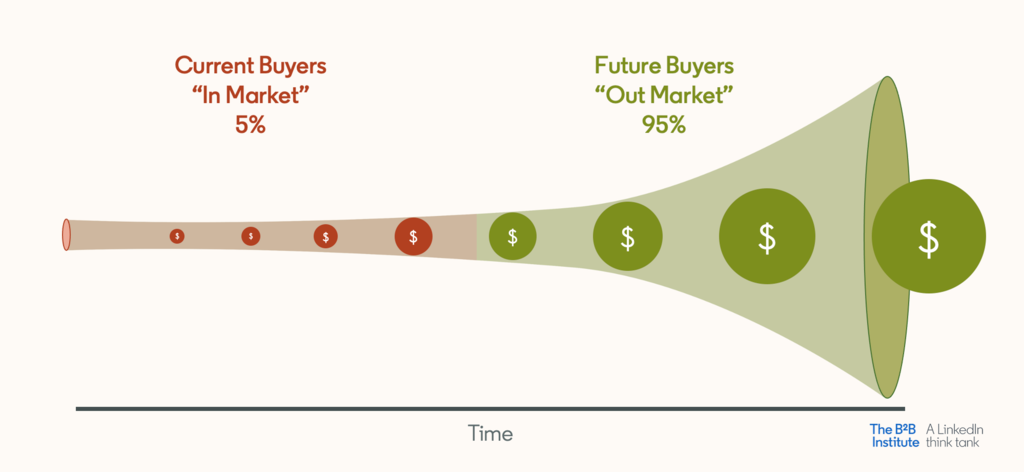
Let me walk through a real example from one of our B2B clients—a marketing automation platform targeting mid-market companies.
Traditional approach: They identified an account (let's call it TechCorp) where their target buyer persona, the VP of Marketing, visited their website, downloaded a whitepaper on marketing efficiency, and opened three nurture emails. After five touches, they scored her as an MQL and passed her to sales.
Sales contacted her. She was interested but said "We're in early evaluation stages, let me loop in our VP of Sales and director of operations." The deal went quiet for six weeks. When it restarted, there were now four stakeholders involved, and the buying criteria had completely shifted. It's now focused on sales team enablement, not marketing efficiency.
Marketing's forecast didn't capture this. Sales didn't predict it. Because nobody was actually watching the full buying committee.
Here's what Signal Layering would have revealed:
-
Week 1-2: VP of Marketing visits website, downloads whitepaper → Intent Signal (Medium confidence)
-
Week 2: VP of Marketing opens nurture emails → Engagement Signal (Medium confidence)
-
Week 3: Director of Sales Operations visits website, views case studies on sales enablement → New Stakeholder Signal (High confidence—now we know a second decision-maker is researching)
-
Week 4: Operations Manager views the implementation and integration documentation → Third Stakeholder Signal (High confidence—infrastructure evaluation starting)
-
Week 4: VP of Marketing attends your virtual webinar, but so do two other attendees from TechCorp (tracked via email domain) → Coordinated Behavior Signal (Highest confidence—multiple stakeholders engaging simultaneously)
-
Week 5: Content consumption pattern analysis shows all four stakeholders have collectively reviewed 80% of your educational content library, touching different use cases → Multi-Stakeholder Depth Signal (Buying committee forming)
At Week 5, the account is now scored as "Active Buying Committee" with 92% confidence. Sales is alerted not with "here's an MQL" but with "this account shows coordinated evaluation across four identified stakeholders. Director of Ops is the least engaged—she may be a key influencer if you can earn her trust early."
The deal doesn't go quiet. Sales understands the committee structure. Marketing understands that sales enablement, not marketing efficiency, is the actual business case. The forecast doesn't break because we're not predicting based on one person's behavior—we're predicting based on a committee's coordinated activity pattern.
The client signed that deal 40% faster than their average cycle because the entire team understood the buying committee from day one.
The Data Stack That Powers This
Signal Layering isn't magic. It's engineering. And it requires a specific data infrastructure that most B2B marketing stacks don't currently have.
You need first-party behavioral data, third-party intent data, dark signals infrastructure, email and engagement data, CRM and sales motion data, and account identification and tracking. Most teams we work with are operating with only 2-3 of these layers. Best-in-class teams have all six integrated into a single scoring algorithm.
Why This Is Hard?
I want to be clear about something: rebuilding your demand gen to operate on signal-based buying group targeting is legitimately difficult. It's not a Marketo workflow change. It's architectural.
You're committing to technology consolidation and integration cost, data quality work, organizational alignment shifts, forecast accuracy pain during transition, and constant signal recalibration. This is where many initiatives die.
I'm telling you this because if you're going to do this, you need to commit to it fully. Half-measures won't work.
The Codedesign Shift: What We're Doing Differently
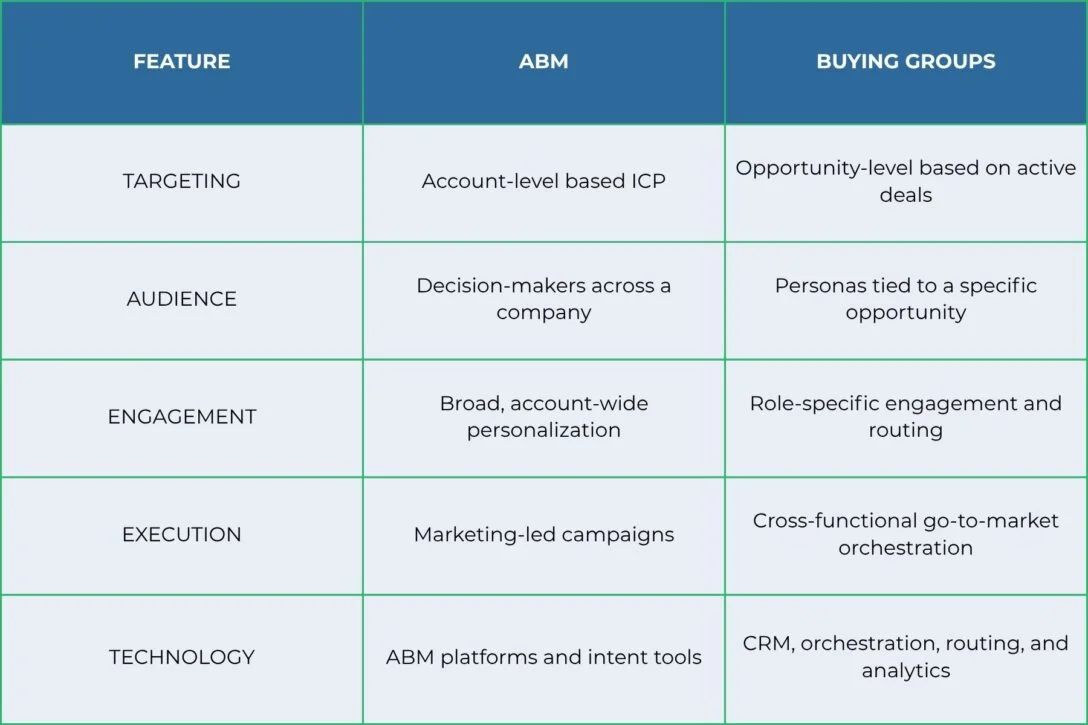
At Codedesign, we've rebuilt our demand generation practice around buying group targeting. We're now auditing our clients' buying committees, not just their personas. We're designing campaigns that reach multiple stakeholders simultaneously with different messaging. We're rebuilding their martech integration so signal layering actually works.
The results have been measurable: average deal cycles shortened by 23%, win rates against competitors increased by 31%, and forecast accuracy improved by 40% within six months of implementation.
Why This Matters Now, Why It Won't Matter Later
Here's what concerns me: in 18 months, signal-based buying group targeting will be table stakes. Every serious demand generation platform will offer it. The vendors who are currently selling "ABM" platforms will rebrand themselves as "buying group targeting platforms." It will become the default expectation.
Right now, it's still a competitive advantage because most teams haven't made the shift. But that window is closing.
The brands winning deals in Q3 and Q4 of 2026 are the ones investing in this now. The brands catching up in 2027 will be fighting for scraps.
The Real Question
Here's what I want to know: Is your demand generation team still optimizing for form fills and single-user conversion, or are they actually mapping buying committees and designing for multi-stakeholder engagement?
If it's the former, you're already losing deals to competitors who've made the shift. You might not see it yet in your win/loss analysis—you might attribute losses to price or features. But the real issue is that your competitor understood the buying committee before you did.
At Codedesign, we're helping B2B teams make this transition—from martech audit to signal stack integration to organizational alignment. If you're serious about this shift, reach out. We've mapped the playbook, and we've seen what works.
The form-based MQL era is over. The buying group targeting era is here. The question is whether you're ready.
