7 min to read
Last Tuesday I was on a new business call with prospect CMO who opened with a sentence I've now heard, in some variation, at least a dozen times this year: "Bruno, our organic traffic is down 31%... I am in trouble"
Nobody needs to be fired. But somebody needs to change how that board measures marketing, and fast — because what's happening right now to search is not a dip, not a penalty, and not a mistake in the tracking setup. It's a structural repricing of attention, and the next 90 days are going to make it impossible to ignore.
Let me walk you through what I'm seeing across our client portfolio at Codedesign, what the data actually says, and what I'd do this quarter if I were sitting in your chair.
The numbers your dashboard is hiding from you
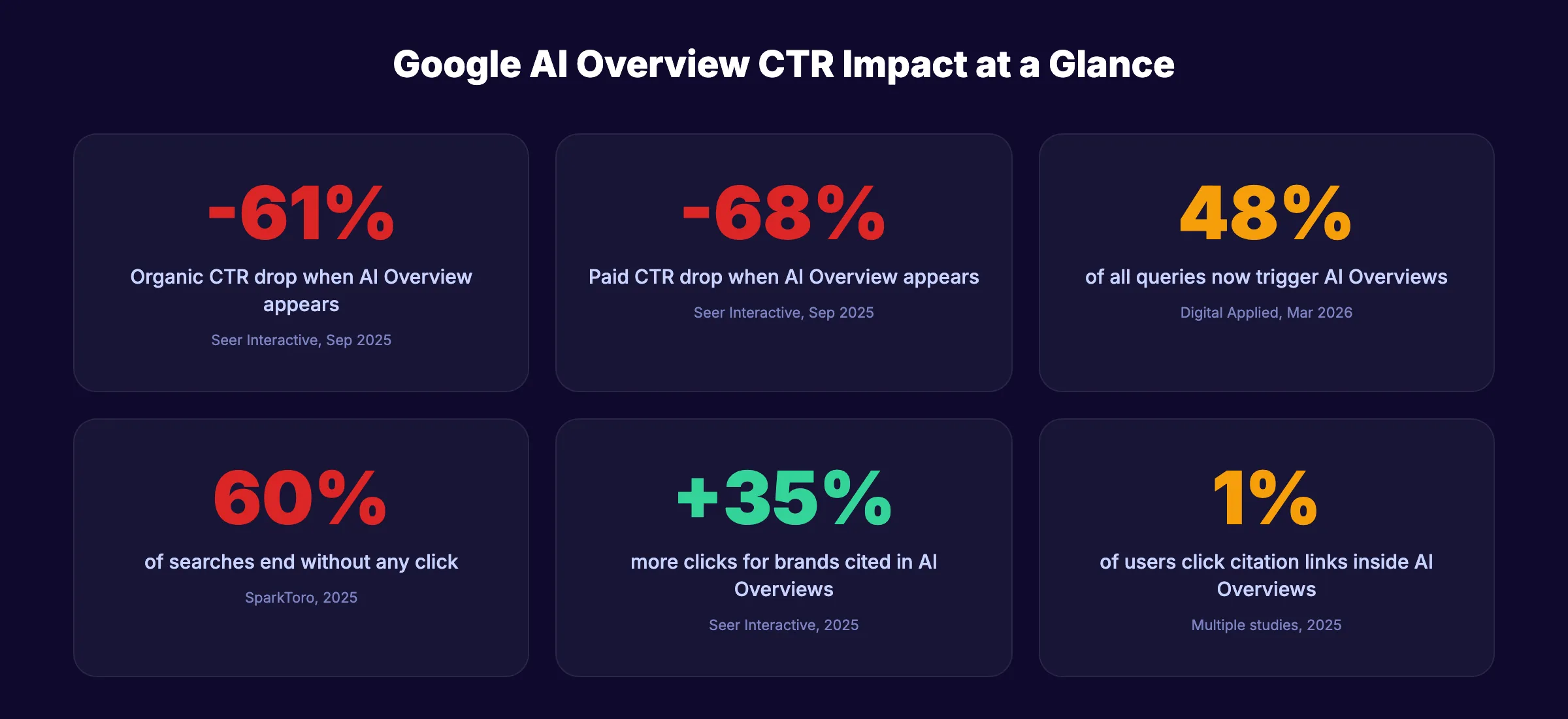
Three figures, and I want you to sit with them for a moment.
First: AI Overviews now appear on roughly 48% of Google search queries. Half. When one shows up, organic click-through rates drop somewhere between 34% and 61% depending on the study you trust.
Second: 93% of searches conducted in Google's AI Mode end without a single click to an external website. Not fewer clicks. Almost no clicks.
Third: zero-click searches overall crossed 68% at the start of 2026, and the curve is still bending upward.
Now add the timing. Google has held a remarkably consistent rhythm with its core updates all year, and every signal points to a broad core update landing in the August–September window. On top of that, Google confirmed it's merging Local Services Ads into the main Google Ads interface starting this month. And in Europe — this one matters enormously if you operate here like we do — France's AI Overviews rollout on July 22 came with publisher opt-outs, AI-traffic transparency and neighbouring-rights compensation baked in. I'd bet good money those terms become the template for the rest of the EU.
So no, your traffic decline is not your SEO agency underperforming. It's the ground moving. The question is whether you're going to keep measuring the old ground.
The uncomfortable opinion
Here it is, and some of my peers in the agency world won't love it: most marketing teams deserve the panic they're feeling, because they spent a decade outsourcing their understanding of demand to a traffic report.
Sessions were always a proxy. A convenient one, a cheap one, but a proxy. What you actually wanted was qualified demand. For twenty years Google was kind enough to hand it to you in a neat blue-link package, and now it's keeping a larger share of the interaction for itself. The marketers who are calm right now are the ones who always measured pipeline, revenue and brand demand — and who treated traffic as an input, not an outcome.
I wrote about a version of this dynamic in The Meta Paradox — the pattern where you spend more on a platform while someone else wins the conversation happening on it. Search in 2026 is the same paradox at a bigger scale: the conversation about your category is increasingly happening inside an AI answer, whether or not you're cited in it.
What we saw with a client in Spanish e-commerce market

Let me make this concrete with a story from our own portfolio. I'll keep the client anonymous — they're a mid-sized e-commerce player in the home and living category, selling across Portugal and Spain, roughly €20M in annual online revenue.
Between March and June this year, their non-branded organic sessions fell about 27%. The initial internal reaction was exactly what you'd expect: alarm, an emergency meeting, a draft brief to re-tender the SEO contract.
Then we looked one layer deeper, and three things jumped out.
Revenue from organic was down only 6%. The clicks that survived the AI Overview filter were converting dramatically better — because by the time someone clicked through, the AI summary had already done the comparison shopping for them. They arrived pre-qualified, closer to the decision, with fewer objections.
Branded search volume was actually up 11%. The brand was being mentioned inside AI Overviews for several category queries — visibility that generated demand without generating a session. People saw the name in an AI answer, and days later searched for it directly.
And the assisted-conversion picture in GA4 showed AI referral traffic — ChatGPT, Perplexity, Gemini — small in absolute terms but growing at a pace that mirrors the 527% growth in AI-sourced traffic the broader market saw through 2025.
So we changed the plan. Instead of fighting to recover raw sessions, we shifted budget into three things: structured content designed to be cited by generative engines, a brand campaign to capitalise on the rising branded demand, and a proper first-party data programme so the client owns the relationship Google no longer hands over. Ninety days later, total revenue attributable to search — organic plus the branded halo — was above the March baseline. Traffic never recovered. Revenue did. Read that sentence twice before your next board meeting.
The 90-day playbook for Marketing Directors
If a core update is coming before the leaves turn — and I believe it is — you have a narrow window to get ahead of it. Here's what I'd do, in order.
1. Change your primary metric before the update forces you to. Move the headline KPI from organic sessions to search-attributed pipeline or revenue. Present branded search volume and AI-citation frequency alongside it. If you walk into September still reporting sessions as your north star, the update will write your narrative for you, and it won't be flattering.
2. Audit your citability, not just your rankings. Run your twenty most valuable commercial queries through AI Mode, ChatGPT and Perplexity. Are you mentioned? Is a competitor? Is a third-party reviewer defining your category for you? This is the new share-of-voice report. We published a full methodology in our GEO Complete Strategy Guide for 2026, and if you only read one thing from Codedesign this year, make it that one.
3. Restructure your best content for extraction. Generative engines reward clear headings, direct answers, named entities, original data and demonstrated expertise. This is where Google's doubling-down on E-E-A-T and the generative engines' citation logic converge: thin AI-produced content is losing on both fronts simultaneously. Your subject-matter experts — the humans with actual experience — are now your most undervalued SEO asset. Put their names, faces and opinions on your content.
4. Build the first-party moat now. Every quarter you delay, the toll booth gets more expensive. Newsletter, community, app, loyalty data — pick your instrument, but own the channel. The brands that treated email as a legacy channel are the ones panicking hardest right now, and that is not a coincidence.
5. Prepare for the European regulatory ripple. If the French model of opt-outs and AI-traffic transparency spreads across the EU — and I think it will — you'll suddenly get visibility into AI-driven impressions you can't see today. Set up your measurement framework now so you can act on that data the day it arrives.
Three objections I keep hearing — and why I think they're wrong
"This only affects informational queries; our commercial keywords are safe." That was defensible in 2025. It isn't anymore. AI Overviews have been expanding steadily into commercial and transactional intent, and AI Mode handles comparison queries — "best CRM for a 50-person team", "X vs Y pricing" — better than a page of blue links ever did. Commercial intent is precisely where the AI layer adds the most user value, which means it's precisely where it will settle. Assuming your money keywords are exempt is planning based on hope.
"We'll just shift everything to paid." You and everyone else — which is exactly the problem. When organic real estate shrinks, paid auctions absorb the displaced demand and CPCs inflate. We're already seeing this across our accounts in competitive verticals. Paid is part of the answer, but as a substitute for organic visibility it's a treadmill that speeds up every quarter. The Local Services Ads migration into Google Ads this month will add its own turbulence to auction dynamics while everyone relearns the interface.
"AI referral traffic is tiny; why invest in GEO now?" Because the compounding has already started, and citation positions are stickier than rankings. Generative engines lean on a relatively stable set of trusted sources per topic, and once that set forms, displacing an incumbent is far harder than winning position three on a results page ever was. The brands earning citations now are writing themselves into the training data and retrieval layers of the next model generation. Waiting for the channel to be big before investing is how companies missed mobile, missed social, and missed marketplaces. The pattern is not subtle.
What I've been reading, watching and listening to
A few things shaped my thinking this month, and I'd rather show my sources than pretend this all came to me in the shower.
On the podcast side, I keep coming back to my conversation with Benjamin Yuille on Voice of Experts about the end of the "average" forecast and probabilistic AI. His argument — that businesses should stop planning around single-point predictions and start planning around probability distributions — maps perfectly onto this moment in search. You don't know exactly what the core update will do. You can still position yourself so that most branches of the probability tree land in your favour.
I also revisited Ethan Mollick's Co-Intelligence on a flight to Madrid, and one line stuck with me: treat AI as a co-worker, not a tool. The marketing version of that idea is treating generative engines as a new distribution partner with its own editorial taste — one you need to understand, feed and negotiate with, rather than trick.
And on the industry side, Search Engine Journal's ongoing coverage of how publishers are adapting to AI Overviews is worth your time, if only to see how the people hit first — media companies — are rebuilding their models around brand, direct relationships and syndication. Publishers are the canary in this coal mine, and the canary is learning to fly differently rather than waiting for the air to clear.
The part where I'm honest about my own business
I run a digital marketing agency. You might reasonably assume it's in my interest to tell you everything is fine, keep buying SEO retainers, nothing to see here. It isn't, and I won't.
The agencies that survive this shift are the ones re-tooling around outcomes — pipeline, revenue, brand demand, AI visibility — instead of deliverables measured in rankings and sessions. At Codedesign we've rebuilt half our reporting stack this year around exactly the metrics I've described above, because our clients' boards were asking questions the old dashboards couldn't answer. It was uncomfortable and expensive and absolutely the right call. If your agency hasn't had that uncomfortable conversation with you yet, ask them why.
Twenty years in this industry has taught me that the moments that feel like crises are usually re-distributions. Attention doesn't disappear; it moves, and it gets repriced. The panic of 2026 will look, in hindsight, like the moment the market separated brands people actually search for from brands that merely intercepted searches. You want to be in the first group, and the work to get there starts this quarter, not after the update lands.
Over to you
Here's my question, and I genuinely want answers in the comments or replies: if your organic traffic fell 30% tomorrow but your revenue held, would your board celebrate or panic? Your honest answer tells you everything about whether your measurement culture is ready for the zero-click era.
If you want the deeper technical playbook, start with our GEO Strategy Guide, and subscribe to Voice of Experts — the next episodes go deep on AI visibility measurement with people building the tools. And if your board meeting is sooner than that, you know where to find me.
— Bruno
