8 min to read
Earlier this week, in a call with a global B2B client, their CMO said something that stuck with me:
“Bruno, my team doesn’t need more tools — we need the tools we already live in to finally work together and think with us.”
On another screen, their team was juggling Outlook threads, Teams channels, Excel reports, and a separate SEO platform, while their operations director quietly added, “And we still end up downloading CSVs and copying things into slides every Monday.”
What is changing right now with Microsoft 365 and n8n is exactly about that gap.
The new n8n integration with Microsoft 365 Copilot (Agent 365) is not “just another automation.” It is a step toward agentic automation: embedding intelligent, semi-autonomous agents directly inside Outlook, Teams, Excel, and Word — and then connecting those agents to thousands of other systems and workflows.
For B2B marketing and SEO, this is the start of a different operating model.
What’s Actually New About Microsoft 365 + n8n
In the last few years, most automation in marketing has looked like this: “When X happens in tool Y, trigger Z.” For example, “When a lead fills a form, send a Slack notification and add them to the CRM.”
Microsoft 365 + n8n changes the nature of what’s “inside” those workflows.
Instead of simple rules, teams can now:
-
Use Microsoft 365 Copilot embedded in Outlook, Teams, Excel, and Word to interpret context, summarize threads, draft responses, and understand intent.
-
Orchestrate those capabilities through n8n, connecting them to CRM, analytics, SEO tools, ad platforms, project management, and internal databases.
-
Turn repeatable processes into agents that can watch for signals, propose actions, and sometimes execute them automatically.
In practical terms, this means a B2B marketing or SEO team can:
-
Have an agent watch brand mentions and search trends, enrich them with CRM data, and drop prioritized opportunities into a Teams channel.
-
Let an agent summarize SEO performance and pipeline impact each week and produce a draft Word or PowerPoint report for review.
-
Allow an agent to monitor content gaps, competitor moves, and internal subject-matter-expert knowledge — then propose new briefs directly in Word.
The real innovation is not a single feature. It is that knowledge work, AI reasoning, and workflow automation are converging in the very environment where people already spend their day.
From Static SEO to Agentic SEO
At a recent conference, a panelist joked, “SEO is still treated like the website’s annual medical check-up.” Run some audits, fix some pages, wait for rankings.
That model is already outdated. With Microsoft 365 + n8n, SEO becomes far more dynamic, continuous, and embedded in daily work.
Think of three eras:
-
Static SEO: One-off audits, manual keyword research, periodic content updates, a lot of copy-paste between tools.
-
Automated SEO: Scheduled crawls, alerts, dashboards, some scripts or connectors to reduce repetitive work.
-
Agentic SEO: Agents that monitor signals, interpret impact, recommend actions, and support or trigger execution — all connected to business context.
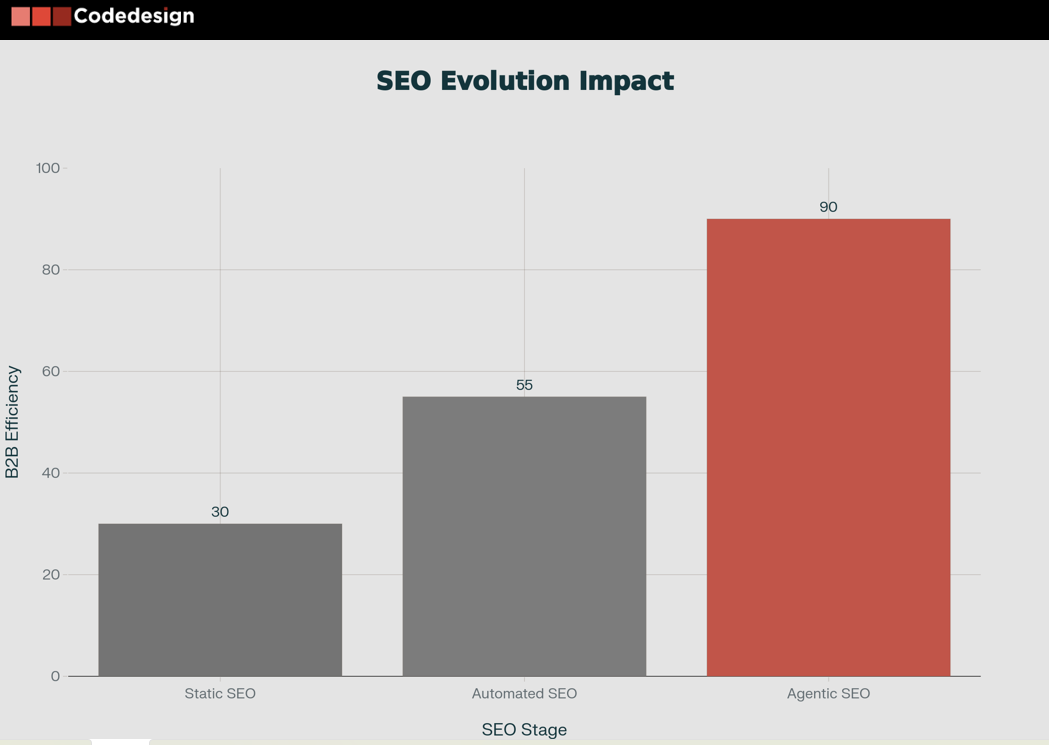
Evolution of SEO towards agentic models and its impact on B2B efficiency
In an agentic model, SEO is no longer just “optimizing pages.” It becomes a living system that:
-
Watches search behavior, competitor movement, and content performance in near real time.
-
Links that to CRM, pipeline, and account data.
-
Surfaces the right next actions — from content topics to technical fixes to sales enablement — directly inside the tools where teams already collaborate.
For B2B organizations, where long sales cycles and complex buying committees are the norm, this shift is especially powerful.
What This Means for B2B Teams: From Fragmented Work to Connected Intelligence
When visiting client offices, it is very common to see this pattern: marketing in one dashboard, sales in another, product feedback in a third, and finance data in a fourth — with PowerPoint or Excel acting as the “integration layer.”
Agentic automation changes this pattern in three important ways.
1. Productivity: Time Shifts From Manual Assembly to Strategic Work
B2B marketing teams today spend a surprising amount of time assembling information rather than acting on it: pulling data, merging spreadsheets, updating slides, re-explaining context in email threads.
With Microsoft 365 + n8n, agents can:
-
Pull SEO and campaign data from multiple platforms.
-
Join it with CRM and revenue data in Excel.
-
Summarize key movements and anomalies in Word.
-
Post tailored summaries to the right stakeholders in Teams or Outlook.
That does not replace human strategy. It reduces the friction before strategic work can even begin.
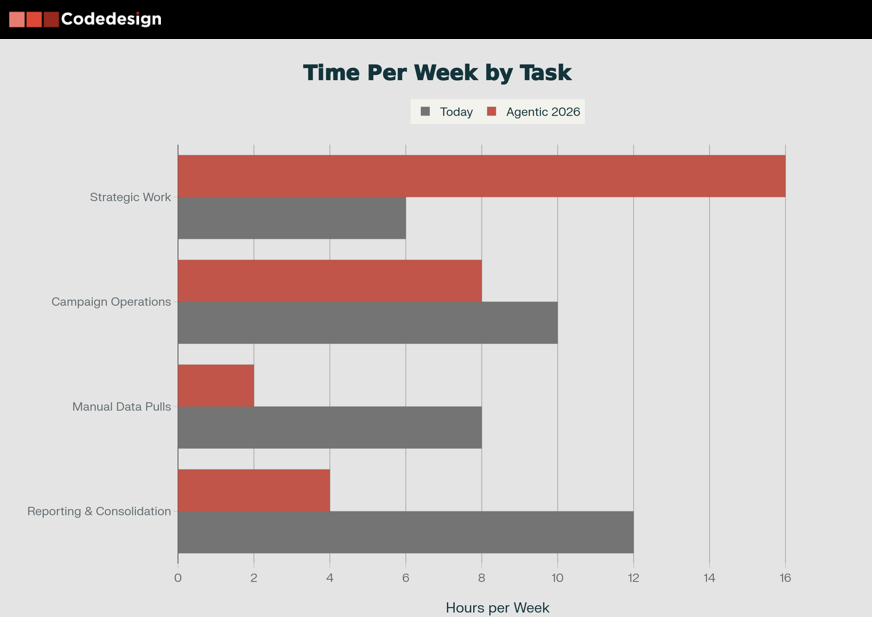
How agentic automation shifts B2B marketing time from manual tasks to strategic work
2. SEO Workflows Become Continuous and Closer to the Business
Instead of monthly SEO “cycles,” teams can have agents that:
-
Monitor shifts in keyword intent and SERP features.
-
Cross-check with account data and target industries.
-
Flag which landing pages, topics, or formats now matter most for pipeline.
-
Push prioritized actions into existing project boards or Teams channels.
This is where SEO becomes a true revenue-supporting discipline, not a siloed craft.
3. Automation Moves Inside Microsoft 365 — Not Only in External Tools
Historically, advanced automation lived in tools “on the side” — marketing automation platforms, custom scripts, integration hubs.
Now, with Agent 365 and n8n, a lot of the intelligence can live:
-
In Outlook (e.g., agents triaging inbound leads, partner requests, or RFPs and linking them to account data).
-
In Teams (e.g., channels where agents post “SEO opportunities” or “competitive alerts” with context and suggested actions).
-
In Excel (e.g., models that are continuously enriched by agents with the latest data).
-
In Word (e.g., auto-generated report drafts, briefs, and summaries).
For knowledge workers, the experience becomes: “I stay in Microsoft 365, but my environment is now intelligent and connected to everything else.”
Knowledge worker using Microsoft 365 apps with embedded AI agents
How B2B Teams Will “Spin Up” Their Own Agents
One of the most interesting shifts is cultural: in-house teams will increasingly build their own agents.
Earlier this month, in a workshop with a B2B SaaS client, their SEO manager mapped out on a whiteboard the workflow they wanted:
-
When organic traffic to high-intent pages drops or spikes beyond a threshold.
-
Pull the relevant segments from analytics.
-
Check CRM to understand which accounts or industries are impacted.
-
Post a summary to a Teams channel, tagging sales and product marketing.
-
Propose two or three recommended actions.
A few years ago, this would likely have required a custom integration project.
With Microsoft 365 + n8n, this same team can now:
-
Use n8n to connect their analytics, CRM, and Microsoft 365 environment.
-
Use Copilot to interpret the data and generate human-readable insights.
-
Turn that flow into an internally understood agent that “watches” and “alerts.”
The mental model shifts from “asking IT for a report” to “spinning up an agent that owns this workflow with us.”
This has implications:
-
Empowerment: Teams closest to the work can design agents that reflect their reality.
-
Speed: New ideas for workflows can be tested in days, not months.
-
Ownership: Marketing, sales, and operations become co-owners of their own intelligent stack.
For B2B companies, this is a competitive advantage in itself: the ability to turn knowledge and process into living systems quickly.
How This Changes the Relationship Between Internal Teams and Agencies
For agencies like Codedesign, this evolution forces an honest question: if clients can build their own agents, what is the role of an external partner?
At a recent leadership roundtable, this topic came up several times. The conclusion was clear: the value of agencies must move up the stack.
Instead of being just executors of campaigns, agencies must become:
-
Architects of cross-system intelligence
Helping clients design how signals should flow across tools: which data sources matter, how to prioritize alerts, how to structure SEO and performance “brains” that live across Microsoft 365, CRM, analytics, and media platforms. -
Governors of quality, risk, and alignment
As more agents act semi-autonomously, questions arise: Are we using the right data? Are we respecting brand and compliance? Are we optimizing for the right outcomes? Agencies can guide frameworks, not just tasks. -
Translators between business strategy and technical implementation
Internal teams may know their business deeply but not always how to translate that into agentic workflows. Agencies with breadth across tools and industries can bridge that gap. -
Performance partners in an always-on ecosystem
When SEO and media are continuously adjusted by agents, the job shifts from “launch a campaign” to “tune the system.” Agencies that live inside this loop — refining prompts, adjusting workflows, interpreting signals — will be essential.
In other words, agencies must become co-owners of an AI-native operating model, not just vendors of isolated services.

From One-Off Optimization to Dynamic, Agent-Assisted SEO Execution
With Microsoft 365 + n8n, the structure of SEO and performance workflows can look more like a loop than a line.
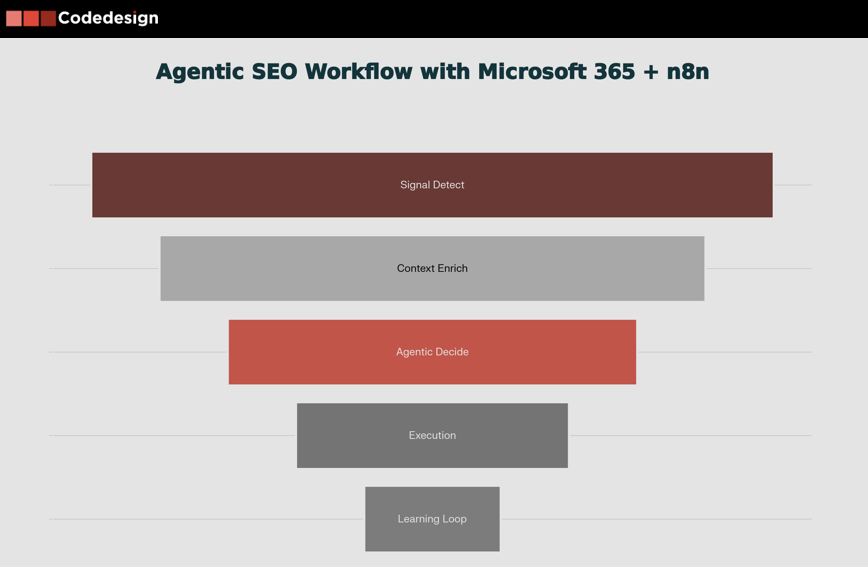
A typical agentic SEO workflow might follow five steps:
-
Signal Detection (Search, Social, CRM)
Agents monitor search trends, SERP changes, content performance, customer tickets, and sales conversations. -
Context Enrichment in Microsoft 365
Signals are enriched with account, industry, and lifecycle context available inside Excel, Outlook, and Teams. -
Agentic Decisioning (n8n flows + Copilot)
Agents reason about “what does this mean?” and “what should we do?” They cluster issues, propose actions, or route decisions to humans. -
Execution (Content, Bids, Outreach)
Actions are translated into briefs, content updates, bid changes, outreach sequences, or UX improvements — either executed automatically or sent to the right team. -
Learning Loop (SEO & Performance)
Results feed back into the system, improving future decisions — a continuous learning cycle.
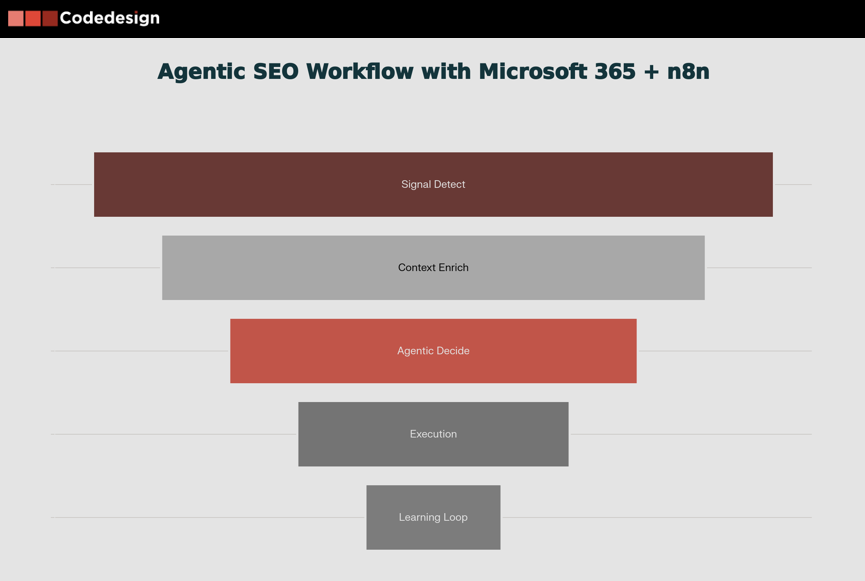
End-to-end agentic SEO workflow leveraging Microsoft 365 and n8n
This loop is where SEO stops being a static checklist and becomes a responsive, learning system integrated with the rest of the go-to-market engine.
The Frameworks and Governance B2B Leaders Need
All of this potential comes with a clear responsibility: B2B leaders must put in place the right frameworks and governance.
From conversations with CMOs and digital leaders over the past year, a few patterns stand out.
1. Define Clear “Agent Charters”
Just like teams have roles and responsibilities, agents should too. For example:
-
“This agent monitors high-intent organic pages and alerts us to anomalies related to pipeline.”
-
“This agent prepares weekly SEO and performance summaries for leadership.”
-
“This agent suggests new content topics based on search, CRM, and sales call transcripts.”
Defining the scope, authority, and success criteria of each agent avoids chaos and duplication.
2. Establish Data and Quality Standards
Agents are only as good as the data and prompts they receive. Governance should cover:
-
Which systems are considered sources of truth.
-
What checks exist before an agent executes changes (vs suggestions only).
-
How brand voice, compliance, and regional considerations are embedded into prompts and guardrails.
Here, agencies can provide reusable templates and best practices across clients and industries.
3. Design the Human–Agent Collaboration Model
The goal is not full automation; it is better collaboration between humans and agents.
Leaders should define:
-
Where humans must approve or override agent recommendations.
-
Which decisions can be delegated to agents once confidence is high enough.
-
How feedback is collected from teams to improve agents over time.
This is less about technology and more about organizational design.
How Agencies Like Codedesign Are Evolving
For Codedesign, this shift resonates strongly with how the agency has been evolving.
Instead of measuring success only by “campaigns launched” or “keywords ranked,” agencies will increasingly be judged by:
-
How well they help clients design their AI-native marketing operating system.
-
How effectively they connect SEO, paid media, CRM, and analytics into coherent, intelligent workflows.
-
How they support internal teams in becoming builders of their own agents, not just users of external services.
In practical terms, that means agencies must:
-
Invest in integration and automation capabilities — not just media and content.
-
Become fluent in Microsoft 365, n8n, and the surrounding ecosystem.
-
Build repeatable blueprints for agentic SEO, reporting, and go-to-market operations that can be adapted to each client.
The agency becomes a strategic systems partner — still deeply involved in creative and performance, but also in the architecture that makes marketing work continuously and intelligently.
A Glimpse at 2026: AI-Native Marketing Ecosystems
Looking to 2026 and beyond, an AI-native B2B marketing ecosystem will likely look very different from what many organizations operate today.
A few characteristics stand out:
-
Living SEO systems
SEO is not a quarterly project. It is an ongoing system where agents monitor, adapt, and propose actions every day, linked directly to accounts and revenue. -
Embedded intelligence in everyday tools
Outlook threads that know which account tier an email comes from. Teams channels where agents summarize campaign impact. Excel sheets that update with contextual insights, not just numbers. -
Teams as builders, not only operators
Marketers, sales ops, and RevOps teams regularly “spin up” or refine agents using Microsoft 365 + n8n. Building workflows becomes part of the job, not a separate IT request. -
Agencies as architects and stewards
Agencies design the overall intelligence layer, ensure quality and governance, and continuously tune the system for performance — alongside running campaigns and creating content. -
Faster, more aligned decision-making
When the right signals, context, and recommendations appear where people already work, decisions become both faster and better aligned with strategy.
The organizations that will win are not necessarily those with the biggest tech stacks, but those who turn their knowledge, processes, and data into connected, intelligent systems — and do so in a way that is sustainable, governed, and human-centric.
Microsoft 365 + n8n is not the entire story, but it is an important chapter. It brings the future of SEO and performance marketing much closer to where B2B teams already live today — in their inboxes, their documents, their chats, and their spreadsheets.
For leaders, the question is no longer if this shift will happen, but how quickly your organization and partners can adapt to it — and whether you choose to be a passive user of AI, or an active architect of an agentic marketing ecosystem.
Knowledge worker using Microsoft 365 apps with embedded AI agents

Add comment ×