8 min to read
I was on a call with a client's CMO last week — a smart, seasoned marketer who has been buying Google ads since the days when "quality score" was the most exotic thing in the room — and she asked me a question that stopped me mid-sentence: "Bruno, if nobody clicks anymore, what exactly am I paying for?"
It's the right question. And after spending the last few weeks digesting what Google announced at Marketing Live and watching the first formats actually roll out into accounts this summer, I think most Marketing Directors are about to answer it wrong.
The ads are no longer next to the answer. They are the answer.
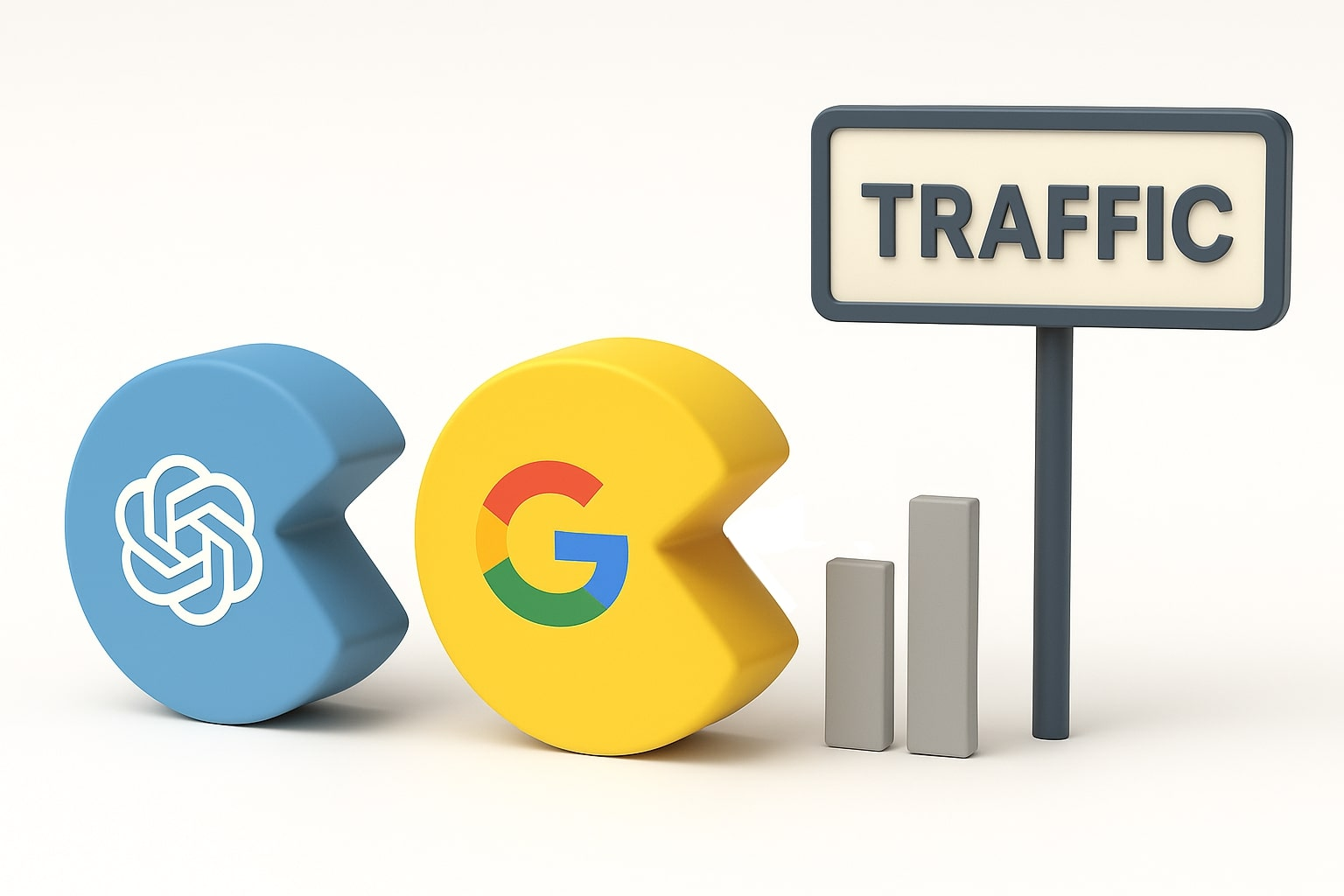
Let me recap what actually changed, because the coverage has been noisy and the substance matters. At Google Marketing Live in May, Google announced a new generation of ad formats built with Gemini, and over the past few weeks they've started appearing in the wild. Four formats deserve your attention: Conversational Discovery ads, which generate creative tailored to the specific question someone typed into AI Mode; Highlighted Answers, where your ad appears as one of the recommendations inside an AI-generated list; AI-powered Shopping ads, where Gemini writes a custom explainer for why your product fits; and Business Agent for Leads, which puts a chat agent trained on your website directly inside your ad unit.
Notice the pattern. None of these formats sit beside the search results. They live inside the AI response itself. Google is not decorating the answer with advertising — it is weaving advertising into the fabric of the answer, with an "independent AI explainer" wrapped around your creative to make it feel less like an ad and more like advice.
And then there's Direct Offers, which I think is the most underrated announcement of the lot. Since the pilot launched in January with brands like Chewy, Gap and L'Oréal, Google has been surfacing deals inside AI conversations during the exploration phase — before the shopper has even decided what they want. Now it's expanding: promotion bundling, travel offers through partners like Booking and Expedia, and — read this twice — native checkout inside Google for merchants on the Universal Commerce Protocol. The shopper researches in AI Mode, gets an offer constructed by Gemini, and completes the purchase without ever visiting your website.
The number nobody wants to say out loud
Here is the statistic that should be on a slide in your next board meeting: by most independent analyses, somewhere between 92% and 94% of AI Mode sessions currently end without a single click to an external website. AI Mode has crossed a billion monthly users and queries are more than doubling every quarter. Google's own commissioned research says 75% of people make faster, more confident decisions using AI Mode.
Put those together and the picture is brutal in its clarity: intent is being resolved inside Google. The research, the comparison, the shortlisting, increasingly the discount and soon the checkout — all of it happens before the user ever reaches the property you spent twenty years optimizing. Your website is becoming the warehouse, not the shop window.
I've been saying a version of this for two years — we wrote about the false comfort of "AI content penalties" in Google Didn't Kill AI Content — You're Just Using It Wrong on the Codedesign blog — but the monetization of AI Mode makes it concrete. When Google starts selling placements inside the answer, the answer becomes the marketplace. Everything else is logistics.
What happened when we repositioned a client for this
Let me make this practical with a case from our own portfolio. One of our clients at Codedesign is a mid-sized home and lifestyle retailer selling across Portugal and Spain — strong brand locally, heavily dependent on non-brand Shopping campaigns and top-of-funnel SEO content for new customer acquisition. Classic profile. In the first quarter of this year, they saw the pattern many of you have seen: impressions climbing, clicks flat-to-declining, and a slow bleed in non-brand organic traffic that no technical audit could explain. The traffic wasn't going to a competitor. It was going nowhere. It was being absorbed.
So in March we made three bets, and I'll be honest about which ones paid off.
First, we treated the product feed as the primary marketing asset — above the website, above the ad copy. If Gemini is going to write an explainer about why your espresso machine is the right choice, it writes it from your structured data. We rebuilt the feed with the discipline we used to reserve for landing pages: benefit-led product descriptions, complete attributes, GTINs everywhere, review data flowing through, promotions structured in Merchant Center rather than buried in banner images. This was the single highest-ROI work we did. When the AI-powered Shopping formats began appearing, the client's products were eligible and legible. Their share of impressions in AI-surfaced shopping placements is now meaningfully ahead of category peers, and — the metric I care about — revenue from Shopping held while clicks dropped 14%. Fewer, better clicks.
Second, we shifted budget from generic non-brand search into Performance Max and AI Max with tight brand guardrails — not because I love handing Google more automation, but because these are the campaign types that feed the new formats. You cannot appear inside a Conversational Discovery ad from a campaign architecture designed in 2019.
Third — and this is the bet that surprised me — we invested in what I can only call entity marketing: making the brand itself unambiguous to machines. Consistent organization schema, a rebuilt About page with real people and real credentials, digital PR aimed at the publications LLMs actually cite, authors with verifiable expertise. Within a quarter, the brand started showing up named in AI Mode answers for category-level queries where they'd previously been invisible. You cannot buy that placement. You can only earn the machine's confidence that you exist and are who you say you are.
What didn't work? Trying to defend informational blog traffic. We updated, we consolidated, we schema'd everything, and the top-of-funnel "what is / how to" traffic kept evaporating anyway. At some point you have to stop defending the beach and move inland. That content now exists to be cited, not visited — a distinction that changes how you write it and how you measure it.
What I've been reading and listening to on this
A few pieces sharpened my thinking here, and I'd rather credit them than pretend it all came from my shower. Sarah Stemen wrote a sharp piece on the consumer gap in Google's AI monetization story — her core warning, that advertisers shouldn't blindly opt into every automated checkbox Google offers and should instead write their own internal AI policy, is advice I've now stolen for three client workshops.
The team at Monks published a thoughtful take on the agentic shift at GML that reframes the whole thing: you're no longer optimizing a funnel, you're steering a machine. And I finally re-read Ries and Trout's Positioning this summer, forty-five years after publication, and it reads like it was written for the LLM era — the battle was never for the shelf or the SERP, it was for a position in the mind. Now the "mind" includes a model's weights, and the discipline is the same.
On our own podcast, two conversations keep echoing. When I sat down with John Salzinger for Complexity is the Enemy of Impact on Voice of Experts, he made the point that the most sophisticated technology isn't the most complex — it's the most useful. Google understands this better than its advertisers do: AI Mode wins because it removes steps, and every step it removes is a step your brand used to own. And my conversation with Alex Blakeway — is your AI strategy actually killing your sales? — lands harder every month, because the honest answer for many brands adopting these new formats without a strategy is yes.
The 90-day playbook I'm giving Marketing Directors
If you run marketing for a business and you have a quarter to act, here is what I would do — not in some distant AI future, but between now and October.
Audit your AI Mode exposure this week. Search Console now reports impressions inside AI Overviews and AI Mode. Pull it. Most directors I show this to are shocked in one direction or the other — either they're absorbing far more AI exposure than they thought with no plan to monetize it, or they're invisible in the surface where a billion people now shop.
Fix your feed before you touch your ads. Every new format Google announced is generated from structured data. A mediocre feed with great ad copy loses to a great feed with no ad copy. This is unglamorous work and it is the work.
Decide your automation guardrails in writing. Which products can appear in Gemini-generated bundles? What's your floor discount for Direct Offers? Do you want a Business Agent chatting with your prospects, and who owns what it says? If you don't answer these questions, Google's defaults will answer them for you, and Google's defaults optimize for Google.
Rebuild your measurement around influence, not clicks. If 9 in 10 AI sessions end without a click, click-based attribution is measuring the exhaust pipe. Watch branded search velocity, direct traffic quality, feed-attributed revenue, and your citation footprint in AI answers. We're building this measurement layer for clients at Codedesign right now, and the teams that have it are making calmer, better decisions than the ones staring at collapsing CTR curves.
Prepare the CFO conversation now, not in November. When these formats scale, your blended CPCs will look strange, your last-click ROAS will wobble, and someone in finance will ask why performance "dropped." It didn't drop — the measurement moved. The Marketing Directors who walk into that meeting with a one-page explanation of AI Mode economics, a new KPI framework already running in parallel, and a test budget with defined success criteria will keep their budgets. The ones who show up with a collapsing dashboard and a shrug will not. I've watched this movie at every platform shift since 2008, and the script never changes: budgets follow the person who can explain what's happening.
And finally: keep publishing genuine expertise, but change why. The content that survives — in rankings and in AI citations — is the content machines can't fake: first-hand experience, opinion with a spine, proprietary data. Write to be the source, not the destination.
A note on Europe, because almost nobody covering this is writing from Lisbon
One more angle, since most of the commentary on GML comes out of the US. The rollout of these formats in European markets will be slower and messier — the DMA, the AI Act, and the usual regulatory friction mean features like native checkout and Business Agent will arrive here months after they hit American accounts. Some directors read that as a reason to relax.
I read it as the single best gift you'll get this decade: a preview window. You can watch exactly how these formats behave in US accounts, learn from the brands that burn budget figuring them out, and have your feed, your guardrails, and your measurement ready the day they switch on in Iberia, France, or Germany. In our client base, the multi-market brands are already running exactly this play — testing aggressively in their US and UK accounts, documenting what works, and pre-building the infrastructure in their EU markets. When was the last time Google gave you six months' notice on anything?
The same logic applies if you're a smaller business without a seven-figure media budget. You can't outspend the enterprise brands inside Direct Offers, but you can out-structure them. Feed quality, entity clarity, and genuinely useful product data are not pay-to-win. Some of the best AI Mode visibility we're seeing belongs to niche retailers whose data is simply cleaner than the giants they compete with.
My honest take
I'm not a doomsayer about this. I've run Codedesign through the death of organic reach on Facebook, the arrival of mobile-first indexing, GDPR, the cookie apocalypse that kept being postponed, and every "SEO is dead" cycle since 2008.
The pattern is always the same: the platforms enclose the commons, the lazy money gets burned, and the brands that adapt early buy market share at a discount while their competitors are still arguing about whether the change is fair.
What I am is impatient with denial. I still sit in rooms where the conversation is about defending 2023's KPIs instead of building 2027's position. I understand the instinct — nobody wants to tell the board that the channel mix that made their career is being dismantled by a chatbot. But the discomfort of that conversation is nothing compared to the discomfort of having it two years too late, after your category's AI shelf space has been claimed by someone faster.
Fair has nothing to do with it. Google is monetizing the discovery layer because it can, and the window where your competitors haven't adjusted is the opportunity. Twelve weeks of feed discipline, entity work, and measurement rebuilding will position you better than twelve months of waiting for clarity that isn't coming.
So here's my question for you, and I genuinely want answers in the comments: what percentage of your search sessions are already ending inside Google's AI — and do you actually know the number, or are you guessing? If you're guessing, that's the first thing to fix. And if you want a second pair of eyes on your AI Mode exposure, the team at Codedesign does these audits every week — or start by digging through the conversations on Voice of Experts, where the people building this stuff explain what's coming next.
Hit reply or leave a comment. I read everything.
— Bruno
 |
Author BioBruno Gavino is the Founder & CEO of Codedesign, an international digital marketing agency helping growth-stage companies build data-driven, AI-ready marketing systems. This article was written by Bruno with the help of Gemini, Claude and Codedesign Copywriting AI Agents
My Linkedin: https://www.linkedin.com/in/brunogavino/ |
